Breaking News

Luxury marketing is entering a new era. After years of spectacular campaigns, unexpected collaborations and…

The final day of September brings together several developments that reveal where luxury is heading:…
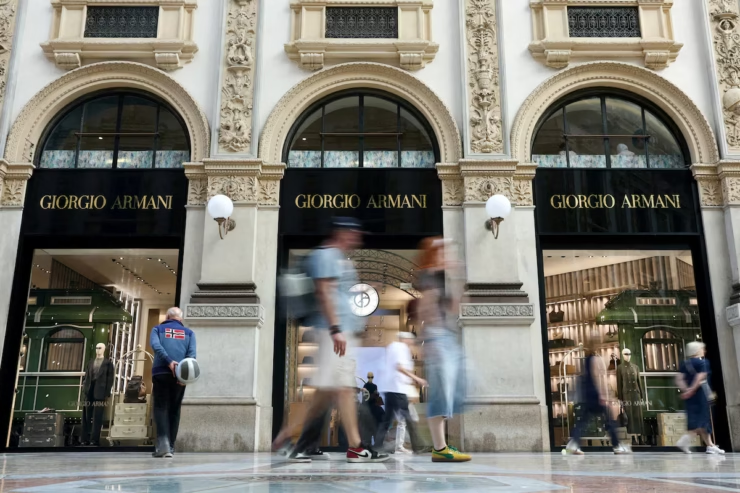
Luxury begins the week with three particularly important developments: Armani says the first 15% stake…

Luxury enters today with a revealing contradiction: the wider market remains under pressure, yet companies…
Today’s radar shows an industry that is no longer expecting a rapid recovery. Milan Fashion…

Volkswagen has slashed its 2026 operating margin forecast to a maximum of 1% and acknowledged a write-down of around €6 billion linked to Porsche. The stock market reaction on 21 September confirms that the German brand is no longer seen as an untouchable exception within automotive luxury.

Current luxury and premium sector news focuses on high-end hospitality and travel. London hosts the World’s Best Summit, Dubai strengthens its hotel leadership, and Cancun welcomes its first Grand Hyatt. These developments reflect how luxury tourism is evolving towards more sophisticated experiences, aspirational rankings, and the premiumisation of the all-inclusive format, with brands and destinations competing to attract high-spending travellers.

Today’s radar reveals two very different speeds across the luxury market. Loro Piana is investing…

Today’s radar shows a luxury market moving away from indiscriminate expansion and towards brand identity,…
Today’s radar points to an increasingly concentrated luxury economy: heritage, top clients, physical experience, hard…

Today’s radar reveals an increasingly clear pattern: major luxury groups are strengthening jewellery, retail technology…

Today’s radar shows a luxury industry becoming increasingly global and less dependent on its traditional…

Today’s luxury radar points to a particularly interesting shift: China no longer wants to be…
The luxury market is delivering an increasingly clear message: high-income consumers continue to spend, while…

Today’s luxury radar points to an increasingly clear shift: the industry is rewarding concentration, recognisable…
Today’s luxury radar points to an increasingly clear shift: the industry is entering an era…
September 9 delivers a particularly revealing snapshot of the global luxury market. Richemont is accelerating…

LUXONOMY prepares an ultra-luxury global edition of the Atlas of Excellence for its 30th anniversary
In 2027, LUXONOMY™ Group will celebrate its 30th anniversary with one of the most ambitious…

While much of the luxury industry is focused on artificial intelligence, digital transformation, new markets…

The agreement establishes a long-term framework for collaboration aimed at supporting the continuous professional development of OTB Group’s employees through world-class executive education programs specifically designed for the luxury sector.

For more than a decade, the global luxury industry enjoyed an era of almost unprecedented…

The restructuring of the global luxury industry is no longer focused solely on acquiring high-profile…

The global luxury industry is entering a new structural phase in which growth is no…

What only weeks ago appeared to be a fragile recovery for the global luxury industry…

The first quarter of 2026 has marked a turning point for Hermès. The French maison,…

Dolce & Gabbana has entered a new phase of corporate evolution with the appointment of…

Certified resale is rapidly emerging as one of the most strategic shifts within the global luxury industry. What was once considered a parallel and largely uncontrolled secondary market has evolved into an integrated channel that is reshaping how brands manage value, customer relationships, and product lifecycle.
Leading groups such as LVMH, Kering, and Richemont are increasingly engaging with resale platforms—either by developing their own ecosystems or partnering with established players. The objective is clear: to regain control over a fast-growing market while unlocking new revenue streams and reinforcing brand equity.

The global luxury industry is entering a decisive new phase—one that extends far beyond cyclical slowdown and into structural transformation. Developments over the past 48 hours confirm that luxury is being reshaped by deeper forces: stricter operational control, a redefinition of product value, pressure on legacy retail models, and an accelerated convergence with technology, wellness, and immersive experience.

Spain joins the LUXONOMY Atlas of Excellence, a publication that has documented global excellence for nearly three decades.
With Spain now joining its pages, the LUXONOMY Atlas of Excellence continues to expand its original mission: to build, year after year, a global library of excellence — a publication that does not merely document companies, but preserves the legacy of those who, across industries and nations, help shape the future.

On Saturday, 28 February 2026, attacks by Israel and the United States on Iran opened a phase of direct confrontation that, within hours, moved from the military sphere to the economic one: volatility in energy markets, disruption in air and maritime transport, and operational tension across the Gulf’s major hubs. At the same time, the closure and congestion around the Strait of Hormuz—an artery of global supply—shifted from being a “theoretical risk” to an immediate market factor.
For the luxury sector, crises of this nature are not measured only in weekly sales. They are measured across four levers that, when activated simultaneously, alter purchasing decisions, logistics routes, travel calendars, and even the way a brand protects its reputation: energy prices, transport security, perceptions of stability, and destination accessibility. The result is a more complex landscape for 2026: not necessarily recessionary for global luxury, but more frictional, more expensive to operate, and more unequal across markets and segments.

LUXONOMY™ officially announces the launch of the LUXONOMY – Atlas of Excellence | Spain Edition, the institutional publication that, since 1997, has documented, analyzed, and projected the most exclusive companies within the global luxury ecosystem. Internationally recognized as the LUXONOMY BLACK BOOK, the Atlas has been present for nearly three decades in some of the world’s most prestigious hubs — Dubai, the United States, Switzerland, Italy, France, Japan, Monaco, Singapore, Hong Kong, and Qatar — establishing itself as a strategic reference for business leaders, major wealth holders, and high-level institutional circles.

Chinese sportswear powerhouse Anta has officially opened its first directly operated flagship store in the United States, choosing Beverly Hills as the launchpad for its next phase of global expansion. The move represents far more than a retail opening — it marks a structural shift toward full brand control in one of the world’s most competitive consumer markets.
The opening in Beverly Hills is likely only the beginning of a broader U.S. retail strategy. The key question is not whether additional locations will follow, but how rapidly Anta can convert visibility into sustained market share and cultural relevance.

The global luxury industry is undergoing a structural transformation that goes far beyond product. In 2026, leading maisons have consolidated a clear strategic direction: expand into high-end real estate while turning physical retail into fully immersive cultural experiences. Branded residences and experiential flagships are not a passing trend — they represent a profound reconfiguration of the luxury business model.
Luxury is no longer just product. It is territory, permanence, and curated belonging. And in that transformation lies the competitive battleground of the next decade.

If the earlier decade was defined by consolidation and store rollouts, the current one will be shaped by deep cultural integration in emerging regions, experiential tourism aligned with identity and tradition, and Generation Z as architect of commercial design. Saudi Arabia is constructing a platform that blends heritage, innovation, and ambition, while India demonstrates that luxury growth depends on community, narrative, and generational alignment. The global luxury map is no longer drawn exclusively from Paris or Milan. It is increasingly shaped from Riyadh and Mumbai, with a long-term vision that extends well beyond retail and into influence, culture, and systemic transformation.
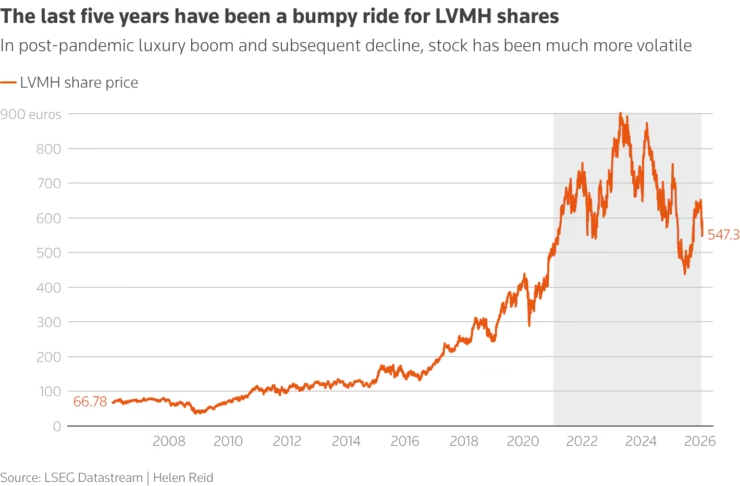
What the industry is witnessing is not a temporary slowdown, but the opening chapter of a new cycle. Near-term luxury will be more analytical, more technologically driven and more attuned to geopolitical and social context. Uncontrolled expansion gives way to precision: fewer openings, better locations; less noise, greater coherence; reduced reliance on any single market.

After two years shaped by slowdown and adjustment, the global luxury market is beginning to show clear signs of recovery. The latest forecasts show that 2026 will mark the start of a new growth phase, driven by the resilience of high-net-worth consumers, strategic recalibration by leading maisons, and the strong performance of key categories like jewellery.