
Luxury & Premium Daily Radar — September 30, 2026 | Balmain redesigns its business model, Courrèges opens a new era in Paris, Neiman Marcus closes its historic flagship and JW Marriott takes premium hospitality into all-inclusive


The final day of September brings together several developments that reveal where luxury is heading: Balmain is rebuilding product, pricing, distribution and retail around the client; Drew Henry makes his Courrèges debut today; Neiman Marcus closes its original Dallas flagship after more than a century while new maisons open stores in Hong Kong and Milan; rhode launches at Sephora across Europe today; a one-of-one Ferrari Enzo comes to market; collectible jewellery and watches return to auction; JW Marriott opens a new all-inclusive proposition; and The Plaza Seoul shuts for three years in order to return with fewer standard rooms and more suites.
Corporate moves + brands | Balmain wants to stop depending almost entirely on ready-to-wear
One of today’s most revealing business stories is the transformation being carried out at Balmain under CEO Matteo Sgarbossa, CMO Bruna Scognamiglio and creative director Antonin Tron. When Sgarbossa joined the company in 2024, almost 90% of revenue came from ready-to-wear. The current strategy is to create a much more balanced maison, with leather goods, footwear and accessories providing greater recurrence and stability. The Sphynx bag, introduced in Tron’s first collection, is one of the products chosen to build this new category architecture.
Balmain also wants direct retail to represent 70% of its business, reducing dependence on wholesale while using boutiques to communicate the house’s identity more effectively. Its new Via della Spiga store in Milan combines current product with archive pieces from 1955 and 1960. Entry prices are also being recalibrated: the mini Sphynx starts below €1,000 and sneakers at €299. The aim is to reconnect with aspirational consumers without returning to an oversized-logo model. It is one of the clearest responses yet to luxury’s central 2026 challenge: lowering the barrier to entry without lowering perceived brand value.
Fashion | Drew Henry debuts at Courrèges today as Paris stages another critical day
The official Paris Fashion Week schedule places Courrèges at 10:30am, The Row at noon, Balmain at 1:30pm, Dries Van Noten at 3pm, Stella McCartney at 4pm, Vaquera at 5:30pm, Acne Studios at 6:30pm and Tom Ford at 8pm.
The morning’s main creative event is Drew Henry’s first runway show as artistic director of Courrèges. The 38-year-old South African designer previously worked at Céline during the Phoebe Philo era, JW Anderson, Phoebe Philo and Burberry. Artémis, the Pinault family holding company that controls Courrèges, selected him following Nicolas Di Felice’s departure and has tasked him with accelerating international expansion while preserving the maison’s futuristic heritage.
Commercial pressure on this generation of creative directors continues to rise. Yesterday Jonathan Anderson presented his latest Dior collection, while Saint Laurent marked Anthony Vaccarello’s tenth anniversary at the house. Reuters noted industry speculation around Vaccarello’s future, although Saint Laurent has announced no departure. The collection followed a 6% revenue decline for the brand last year, while parent Kering returned to growth in the first half of 2026.
Retail | The Neiman Marcus store that helped define American luxury closes today
Neiman Marcus permanently closes its 1618 Main Street Dallas flagship today, ending more than a century of history at one of American luxury retail’s most symbolic addresses. Saks Global says it will concentrate resources on NorthPark Center, a location that generates more than ten times the business of the downtown store. Elements of the historic flagship, including a reimagined Zodiac Room, will move to NorthPark.
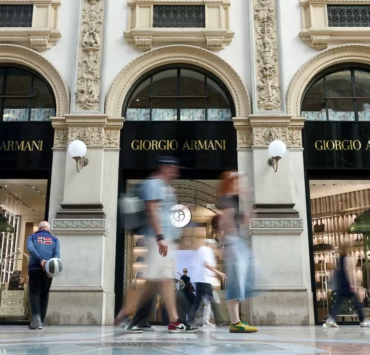
This does not mean luxury is abandoning physical retail. Other markets are producing the opposite move. Maison Joseph Duclos has opened its first permanent boutique outside France at Landmark Atrium in Hong Kong, introducing a local exclusive made from its rare black Héritage leather. Balmain has just opened Via della Spiga, while Prada is expanding large-format private-client environments.
The data helps explain the apparent contradiction. US luxury leasing fell 46% year on year in the first half of 2026, but average flagship size has increased by more than 30%. Brands increasingly appear to want fewer stores, in better locations, with larger footprints and stronger clienteling and experiential capability.
Beauty | rhode arrives at Sephora Europe today as Molton Brown recruits prestige-fragrance expertise
rhode, founded by Hailey Bieber and now part of e.l.f. Beauty, launches today, September 30, at Sephora across Europe and the UK. Alongside its core skincare and hybrid-makeup assortment, the launch includes Sephora-exclusive and limited-edition products. Europe therefore becomes a new test of how quickly one of beauty’s strongest digitally built communities can convert into international physical retail.
At the same time, Kao has appointed Laura Hogan Chief Marketing Officer of Molton Brown. Hogan joins after nine years at The Estée Lauder Companies, most recently leading Le Labo, Kilian Paris and Frédéric Malle in the UK and Ireland, following earlier experience across Jo Malone London, Tom Ford Beauty, Bobbi Brown and ELEMIS. Her remit spans brand strategy, product, visual merchandising, store design, digital marketing and creative services as Kao positions Molton Brown as one of the strategic brands driving its international cosmetics growth.
Another boundary is therefore disappearing: prestige beauty is learning the disciplines of luxury fashion — brand architecture, owned retail, scarcity, storytelling and clienteling — while digital-native brands learn how to build physical presence.
Luxury automotive | The future of a one-of-one Ferrari Enzo is decided today
RM Sotheby’s closes its Sealed September sale today, a private-bidding format featuring carefully selected collector cars. The catalogue includes a Mercedes-Benz 300 SL Gullwing, Gordon Murray Automotive T.50, Ferrari 458 Speciale A, Ferrari 550 Barchetta and, above all, a one-of-one Ferrari Enzo.
The 2004 Enzo is the only example Ferrari originally finished in Matte Nero Opaco. It was specified by a member of the Brunei royal family, retains its original chassis, engine, gearbox and bodywork, carries Ferrari Classiche certification and showed just 5,763 kilometres when catalogued.
Collector cars are increasingly following the same logic as haute horlogerie and high jewellery: iconic model + exceptional provenance + unreproducible specification + documentation. The vehicle stops competing merely with other cars and begins behaving more like a cultural collectible.
Watches + high jewellery | Harry Winston, Cartier, Bulgari, Rolex and Lange go under the hammer today
John Moran Auctioneers holds a dedicated Jewelry & Watches sale today in California featuring Harry Winston, Van Cleef & Arpels, Cartier, Bulgari, Tiffany & Co., Buccellati, Rolex, A. Lange & Söhne, Vacheron Constantin and Ulysse Nardin. Highlights among the gemstones include a 5.60-carat unheated Burmese ruby, an 11.88-carat Colombian emerald and a 5.08-carat Paraíba-type tourmaline.
The watch selection includes a stainless-steel Rolex Submariner, an 18-karat gold Rolex Day-Date President reference 1803 and an A. Lange & Söhne Saxonia Thin in rose gold, among other pieces. The secondary market continues to reinforce one of September’s clearest trends: buyers increasingly favour objects that combine recognisable signatures, scarcity, provenance and the ability to be preserved across generations, rather than simply new product.
Luxury travel | JW Marriott opens a new frontier today: luxury all-inclusive
JW Marriott Costa Elena Resort & Spa opens today, September 30, in Guanacaste, Costa Rica. Marriott positions the property as a JW Marriott all-inclusive proposition combining oceanfront accommodation, dining, wellness, curated activities and the Griffin Club, an additional layer of privacy and personalised service.
The opening deserves attention because all-inclusive is no longer confined to high-volume leisure. Major hotel groups are turning the format into a premium, high-yield hospitality model, removing friction from the guest experience while capturing a much larger share of spending within the resort.
The next stage could be even more interesting: all-inclusive combined with private villas, advanced wellness, chef-led gastronomy, exclusive clubs and deep personalisation. Luxury does not necessarily need to charge for every experience separately in order to communicate exclusivity.
Hospitality | The Plaza Seoul closes for three years today to return with fewer rooms and more luxury
In Seoul, The Plaza suspends operations today ahead of a complete rebuild intended to reposition the property as an ultra-luxury hotel in 2029. Hanwha Hotels & Resorts plans to reduce the proportion of standard rooms, increase high-end suites, expand the club lounge, reinforce fine dining and add a rooftop garden open to both hotel guests and Seoul residents. The property is also exploring membership in The Leading Hotels of the World.
The project echoes a broader pattern already visible in Seoul hospitality: sacrificing room count in order to increase room size, ADR, services and spend per guest. Hospitality is beginning to apply a logic very similar to that of luxury maisons: lower volume, deeper relationships and an experience that is harder to substitute.
Trend of the day | Luxury enters an era of selective concentration
The pattern on September 30, 2026 is unusually consistent. Neiman Marcus removes a historic asset because another store generates more than ten times its business. Balmain wants to narrow distribution and move direct retail towards 70%. Joseph Duclos makes only its first international move, but chooses one of Hong Kong’s strongest luxury addresses. JW Marriott redefines all-inclusive. The Plaza Seoul removes standard product to add suites. RM Sotheby’s sells objects designed around near-total rarity.
Retail data points in the same direction: fewer openings, but larger flagships concentrated on the strongest streets.
The next phase of luxury growth may therefore depend less on expanding distribution and more on concentrating capital where a brand possesses a genuine advantage: better clients, better locations, stronger products, private services, hospitality, craftsmanship and access.
The LUXONOMY view
The central theme of September 30, 2026 can be summarised simply: luxury is beginning to abandon the obsession with being everywhere.
During the previous decade, the formula appeared straightforward: more stores, more markets, more categories, more ecommerce and more aspirational customers. In 2026, a different architecture is emerging. Balmain is reducing wholesale to control presentation. Neiman Marcus is keeping Dallas but moving activity towards the asset that actually performs. Joseph Duclos chooses Hong Kong for its first step outside France. The Plaza reduces room count. Collectors pay more for configurations that cannot be replicated.
This may even change how luxury companies measure success. Not only number of stores, but sales per store; not only guest count, but spend per guest; not only followers, but high-value clients; not only units, but margin and retention.
Discover more from LUXONOMY
Subscribe to get the latest posts sent to your email.