
Luxury & Premium Daily Radar | Armani opens a new chapter, LVMH-Hermès returns to the spotlight and luxury concentrates more business among its very best clients


Today’s radar points to an increasingly concentrated luxury economy: heritage, top clients, physical experience, hard luxury and disciplined expansion are regaining importance over indiscriminate growth. Armani has brought an outside designer into its historic creative structure for the first time; documents reviewed by Reuters reopen one of the most complex chapters in the rivalry between LVMH and Hermès; Alexandre Arnault joins Nike’s board; Net-a-Porter and Mr Porter return to growth; London Fashion Week begins today with Burberry, Alexander McQueen and Mulberry among the most closely watched names; McLaren commits £500 million to expansion and its first SUV; and The 50 Best Hotels confirms Asia’s growing influence over global luxury hospitality.
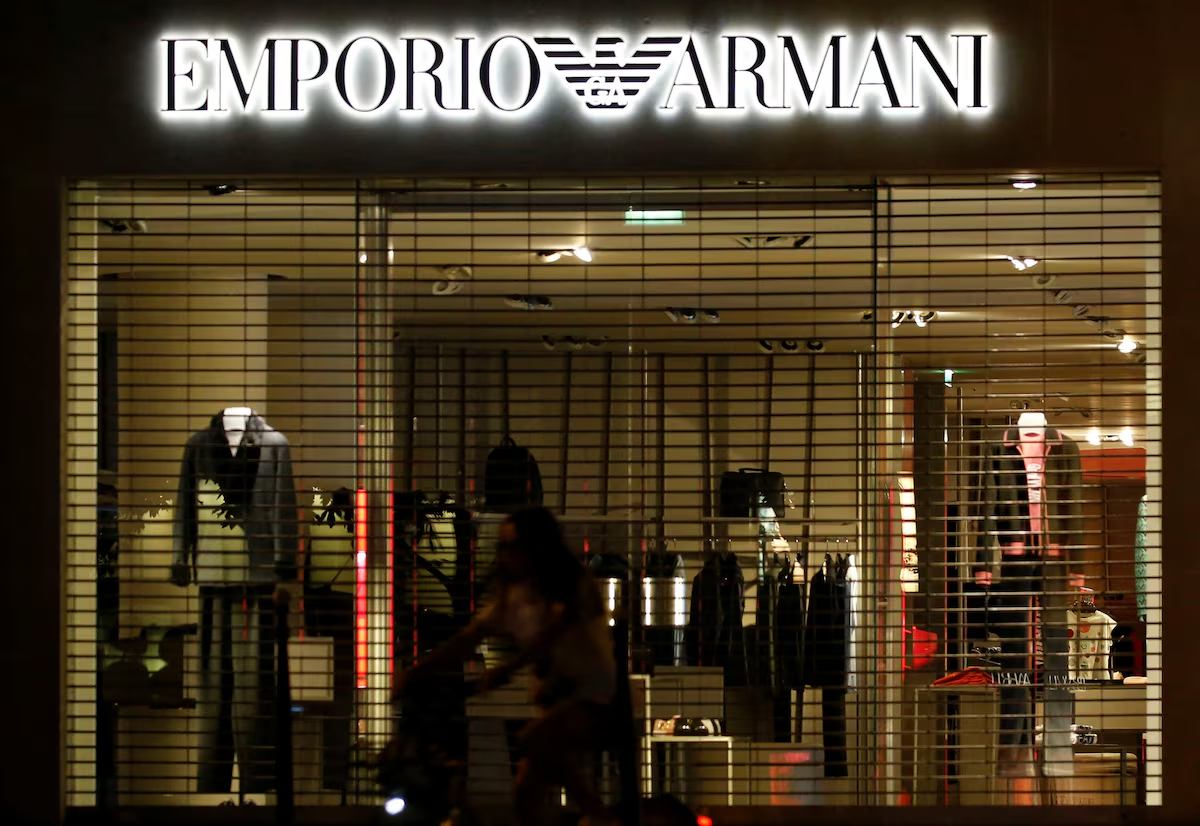
Corporate moves | Armani breaks a historic barrier with Dario Vitale. The Italian group has appointed Vitale creative director of Emporio Armani and Giorgio Armani Accessories. He becomes the first designer from outside the house’s historic inner circle to take on such a senior creative responsibility, one year after Giorgio Armani’s death. Vitale arrives after more than a decade at Miu Miu and a brief period at Versace, as the group simultaneously prepares for another crucial decision: Armani’s will calls for the sale of a 15% stake in the company. His first Emporio Armani collection will be presented on September 24, 2026 during Milan Fashion Week, through a presentation rather than the traditional runway format. The business message is clear: Armani wants to preserve an extraordinary legacy without becoming trapped by it, and outside creative talent is arriving before a potentially much broader ownership transition.
LVMH + Hermès | Reuters uncovers new documents in a corporate battle many believed had ended more than a decade ago. An investigation published today, September 17, reports that legal documents show LVMH signed a 2002 agreement to acquire Hermès heir Nicolas Puech’s shares, a stake of roughly 6% now worth around $10 billion. LVMH stated in a June court filing that it had never intentionally sought to acquire Puech’s holding and says the agreement was never executed. Reuters also reports more than $20 million in payments between 2001 and 2009 to the firm of Puech’s former wealth manager. The ultimate fate of the shares remains unresolved and legal investigations continue, so documented facts should be separated carefully from allegations that have not been proven. For the luxury industry, the wider lesson is striking: truly scarce luxury companies can become contested assets for decades because corporate rarity can be every bit as powerful as product rarity.
LVMH + sport | Alexandre Arnault joins Nike’s board as luxury and sportswear move closer together. Nike has appointed 34-year-old Alexandre Arnault, currently Deputy CEO of Moët Hennessy, to its board of directors. His résumé includes transforming Rimowa and four years at Tiffany & Co., where he helped connect high jewellery with sport, culture and younger audiences. Nike is working through a commercial turnaround and wants deeper expertise in innovation, brand building and consumer engagement. The wider luxury story is equally compelling: LVMH has steadily expanded its exposure to sport through Paris 2024, Formula 1 and other investments, and now one of its most visible executives joins the governance of the world’s largest sports brand. Sportswear, luxury, entertainment and culture are increasingly competing in the same arena of desirability.
Digital retail | Net-a-Porter and Mr Porter return to growth, but the real story is who is spending. LuxExperience, owner of Mytheresa, Net-a-Porter, Mr Porter and Yoox, reported €653.6 million in fourth-quarter sales, up 7.6% at constant currencies, marking its third profitable quarter since the former Yoox Net-a-Porter group was integrated. Net-a-Porter and Mr Porter grew 5.6% to €273.9 million and returned to profitability, while Mytheresa grew 10.2%. But the most revealing figure is customer concentration: approximately 4.3% of Net-a-Porter and Mr Porter clients generated 49% of GMV, while 4.8% of Mytheresa customers produced 48.4%. Luxury is becoming increasingly dependent on a small group of high-spending wardrobe builders who buy early, pay full price and maintain continuous relationships with retailers.
Physical retail | Hermès replaces its Williamsburg pop-up with a permanent store. The maison is consolidating its Brooklyn presence with a two-level location after initially testing the neighbourhood through a temporary format. The move sits alongside major physical investments from Moncler, Prada, Chanel and other leading houses. Ecommerce may be strengthening again among top clients, but the best physical stores are not disappearing; their purpose is changing. They increasingly operate as clienteling environments, cultural spaces, hospitality venues and long-term relationship platforms rather than simply places that hold inventory.
Fashion | London Fashion Week begins today and attempts to restore London’s position at the centre of global fashion conversation. Spring/Summer 2027 starts on September 17 with a mix of emerging designers and established houses. Burberry and Simone Rocha remain key fixtures; Alexander McQueen returns to London under Seán McGirr; Christopher Kane makes his Mulberry debut; Marks & Spencer prepares its first LFW runway, while Barbour joins the official schedule for the first time. The British Fashion Council is deliberately combining fashion with music, art, technology and retail. After Brexit, the end of tax-free shopping for international visitors and the collapse of Matches, London appears increasingly determined to compete not by imitating Paris or Milan but by turning experimentation, emerging talent and cultural crossover into its core advantage.
Watchmaking | Rolex is beginning to enter territory historically dominated by Patek Philippe. The new Perpetual Padellone — annual calendar, moonphase, precious metals and prices around £50,000-£60,000 — is generating one of the industry’s most interesting strategic debates. WatchPro notes that the new Rolex sits extremely close to models such as Patek Philippe’s Annual Calendar Moon Phases in both function and price, while some modern Patek complications trade below retail on the secondary market and Rolex retains premiums across a much broader part of its range. The issue is not whether Rolex will replace Patek. It is whether The Crown is now using its immense brand power to climb further into complications, exceptional pieces and six-figure collectability, increasing average value without having to manufacture more watches.
Jewellery | Consumers’ jewellery boxes already contain the equivalent of roughly a decade of global gold production. A new Watch & Jewellery Initiative 2030 report estimates that approximately 97,000 tonnes of gold and 790,000 tonnes of silver are already held by consumers, an “urban mine” comparable to or larger than what many active mines will produce over the coming decade. The report says recycled gold can generate up to 99.8% lower emissions than newly mined gold without losing quality, while roughly half of luxury-watch owners report owning at least one watch they never wear. The commercial opportunity is substantial: resale, take-back programmes, recycling and metal recovery could become a new supply channel for jewellery and watchmaking, reducing mining dependence while creating new services for existing clients.
Luxury automotive | McLaren commits £500 million, prepares its first SUV and abandons growth at any cost. The British manufacturer will invest approximately £500 million — about $675 million — in UK manufacturing and engineering, including a new assembly facility, in-house engines and transmissions and up to 1,000 direct and indirect jobs by 2032. The major product shift will be McLaren’s first SUV, following a route already validated by Lamborghini’s Urus, Ferrari’s Purosangue and Bentley’s Bentayga. McLaren has also reduced dealer inventory and moved towards build-to-order production to limit discounting and protect residual values. Just as tellingly, it currently has no plan for a pure EV because executives do not believe customer demand justifies one. The future of luxury automotive may not electrify at the same pace as the mass market; it will first need to remain profitable, scarce and aligned with what clients actually want to buy.
Hospitality | Rosewood Hong Kong is named the world’s best hotel again as Asia dominates the top end of hospitality. The 50 Best Hotels 2026 has placed Rosewood Hong Kong at No.1 for the second consecutive year, making it the first property to repeat the title. Capella Bangkok ranks second and Four Seasons Bangkok at Chao Phraya River third, while Asia places 18 hotels in the global top 50. Rosewood Hong Kong operates at an unusual scale for ultra-luxury — more than 400 rooms and suites with around 1,200 staff — while maintaining deeply personalised service. Europe still leads the overall count with 21 properties, but the benchmark for contemporary luxury service, personalisation and operational sophistication is increasingly being shaped in Asia.
Hospitality + travel | Hyatt opens The Clayfield today in Niagara-on-the-Lake, illustrating the potential of luxury beyond major capitals. The new Unbound Collection by Hyatt property opens on September 17 in Canadian wine country with 102 keys — 60 hotel rooms and 42 residences — alongside a restaurant, rooftop terrace and spa. The hybrid format suits a destination built around vineyards, gastronomy, theatre and longer weekend stays. It is another example of premium hospitality moving beyond oversupplied capitals towards micro-destinations with identity, cuisine, nature and the ability to turn a short visit into a multi-day experience.
Beauty | Chloé turns Le Nectar into music, content and physical experience in Singapore today. From September 17 to 20, Chloé Parfums is taking over Appetite Record Lounge to launch Le Nectar through fragrance, live DJ sets, music, a vintage photo booth and personalised keepsakes. The activation joins similar moves from Chanel, NEST and other beauty houses using hospitality and entertainment to transform fragrance launches into destinations. Perfume is evolving from luxury’s accessible entry product into a cultural platform capable of generating traffic, content and long-term client engagement.
Premium travel | La Compagnie brings skincare and longevity into the business-class cabin. The French all-business-class airline is adding Beau Domaine products — the skincare brand co-founded by Brad Pitt and the Perrin family — to amenity kits on routes linking Newark with Paris, Nice and Milan. Its Airbus A321neos carry only 76 business-class seats and combine flat beds, Champagne and Michelin-designed menus with a growing focus on wellness. The partnership points towards a broader direction: premium aviation, hotels, spas, beauty and longevity are beginning to compete for the same integrated high-value traveller experience.
The LUXONOMY view
September 17, 2026 reinforces one defining idea: luxury is concentrating. It is concentrating around clients who spend dramatically more than average, houses capable of renewing heritage without destroying it, stores worth visiting, hard-luxury objects with lasting value, hotels that remember tiny personal details and automotive brands that can increase margins without chasing volume. The LuxExperience numbers may be the clearest evidence of all: fewer than 5% of clients generate almost half the business of its leading luxury platforms. The next luxury cycle may not be won by recruiting millions of new aspirational shoppers. It may be won by knowing, retaining and expanding relationships with a few thousand exceptionally valuable clients.
Discover more from LUXONOMY
Subscribe to get the latest posts sent to your email.