Luxury & Premium Daily Radar — September 22, 2026 | Milan opens under pressure, Donatella returns with REVOLVE and luxury shifts capital towards top clients, wellness and genuine rarity


Today’s radar shows an industry that is no longer expecting a rapid recovery. Milan Fashion Week begins with LVMH down 37% in 2026, Kering having erased the gains associated with Luca de Meo’s arrival, and fewer than half of luxury brands currently growing. Reuters also highlights a deeper shift: consumers are reallocating spending towards health, wellness, longevity, hotels and restaurants. Luxury is no longer competing only with other maisons; it is competing for money and time that once flowed more automatically into fashion and accessories.
Corporate moves | Donatella Versace is returning to creative business — but outside Versace. REVOLVE Group has formed a joint venture with Donatella to develop a new fashion and beauty business aimed particularly at Millennial and Gen Z consumers, combining her cultural authority with REVOLVE’s technology, infrastructure and digital community. Product is expected to begin launching in 2027, placing Donatella back in an independent creative role after leaving Versace’s design leadership in 2025. REVOLVE generated roughly €1.2 billion in sales last year. The strategic idea is compelling: a creator with global cultural equity can now become a commercial platform without first building the infrastructure of a traditional luxury group.
At the same time, Capri Holdings is back on the M&A radar. WWD reports today that the owner of Michael Kors and Jimmy Choo has held informal discussions with prospective buyers after selling Versace to Prada, with some interested parties reportedly having examined the company’s books. Sources caution that no near-term deal is expected. If the process develops, it could reinforce a new consolidation cycle as depressed valuations force the industry to reassess the value of established luxury assets.
Fashion | Milan Fashion Week SS27 begins today with Prada and culminates tonight in Vogue World: Milano. The September 22-28 schedule opens with Prada at 2pm, followed by Dhruv Kapoor, Diesel and other presentations; Jil Sander, Fendi, Missoni, MM6 Maison Margiela and Etro follow tomorrow. Tonight, the Galleria Vittorio Emanuele II hosts Vogue World: Milano, built around Italian craftsmanship and the importance of the human hand in an era of technology and AI. The timing could hardly be more relevant: as artificial intelligence reduces the cost of imagery, content and inspiration, luxury can increase the economic value of what remains difficult to automate — craft, materials, time and authorship.
Retail | Paris Texas opens its first physical store and chooses central Milan to turn a digitally accelerated brand into an experience. The Italian footwear label has opened at Via Verri 4 in the city’s fashion district, supported by store-exclusive Rouge Noir versions of its Lidia designs. The move reflects a broader shift: digitally successful brands increasingly need physical spaces not necessarily to build vast store networks, but to control presentation, deepen identity and serve their highest-value customers directly.
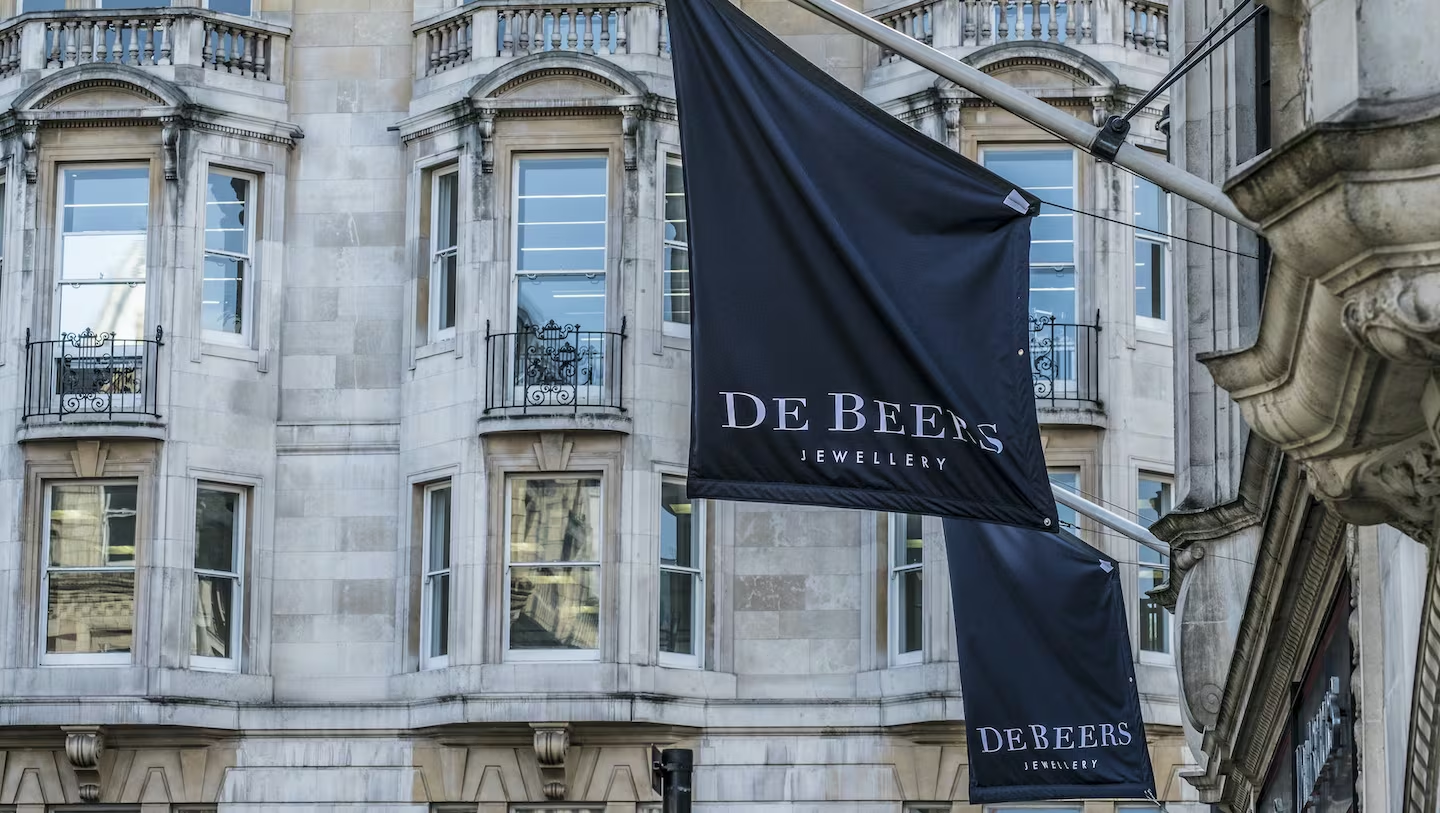
High jewellery | De Beers wants to convert a mining advantage into a design signature competitors cannot easily replicate. Vogue today details the strategy behind Vibrations, the new De Beers London high-jewellery collection launched during London Fashion Week. Its most distinctive innovation is the use of cabochon-cut diamonds as a future maison code. Fewer than 0.5% of diamonds meet the requirements for the treatment, while De Beers’ direct mine access allows it to select suitable stones more efficiently. The collection also includes GemFair-traceable diamonds for the first time and will travel next to Shanghai and Dubai. Jewellery is demonstrating that the strongest storytelling emerges when brand, raw material, provenance and technique belong to the same narrative.
Haute horlogerie | Roger Dubuis pushes métiers d’art towards an extreme with The Metamorph Merlin. The final chapter in its Merlin universe is limited to 28 pieces, uses a 45mm pink-gold case and turns the case flanks into micro-engraved artwork requiring around 70 hours of handwork. Its twelve six-millimetre pink-gold knights can require up to three days of sculpting and finishing each. The automatic RD821 contains 172 components and carries the Poinçon de Genève. The collector market’s direction is increasingly clear: when precision itself is inexpensive, haute horlogerie has to sell what industrial time cannot easily reproduce.
Luxury automotive | Bentley enters the final day before unveiling the Torcal. Tomorrow, September 23, London will host the global reveal of Bentley’s fourth contemporary model line alongside the Continental GT, Flying Spur and Bentayga. The Torcal opens a new chapter for the marque, extending even its electric sound design into emotional territory: Bentley has created an acoustic identity using real instruments and drawing inspiration from the memory of its V8 and W12 engines. Tomorrow’s real test will not be whether an EV can be fast. It will be whether electrification, craftsmanship, materials and emotional character can continue justifying Bentley-level pricing and status when the combustion engine is no longer the central protagonist.
Luxury tourism | Ras Al Khaimah wants to transform its positioning and have 80% of its hotel inventory in the premium category by 2030. The emirate plans to expand from roughly 8,700 keys today to around 16,000, supported by projects from Nobu, Janu, Fairmont, W Hotels, Four Seasons and Wynn Al Marjan Island. Only around 13.3% of the current inventory is luxury five-star. The strategy is ambitious because 2026 has been difficult for regional tourism, with hotel nights and RevPAR under pressure following geopolitical disruption. That makes the decision even more interesting: Ras Al Khaimah is effectively choosing to compete through spend per visitor rather than trying to match Dubai on sheer volume.
Hospitality | Hanoi adds a new hybrid model combining hotel, serviced residences, heritage and wellness. LÈGACY Hanoi – A Fusion Original is celebrating its opening this month with 218 units, including 133 serviced apartments and 85 rooms and suites, alongside YÊN Spa, onsen facilities, restaurants and a rooftop venue. Its design draws on Vietnamese cultural references rather than importing a generic international luxury language. This model — hotel + extended stay + wellness + local identity — is gaining traction because it can capture guests for longer periods while monetising more parts of their day.
Beauty | Independent fragrance continues to professionalise. Heretic Parfum has appointed Blair Lawson as CEO, bringing more than two decades of luxury and beauty experience across Louis Vuitton, goop, Beautycounter and Lunya. The move comes as niche fragrance enters a period of investment, acquisition and international expansion. For independent houses, the next stage is no longer simply creating exceptional scent; it requires distribution, retail, CRM, internationalisation and a brand architecture capable of scaling without destroying the sense of discovery.
Trend | Wellness and longevity are moving from hotel amenities to an investable hospitality category. Discussions ahead of Future Hospitality Summit published today show operators and investors treating prevention, functional nutrition, sleep, personalised health and longevity as part of the economic infrastructure of hospitality itself. That aligns directly with Reuters’ observation that consumers are directing more spending towards health, wellness, restaurants and travel. The future competitor to a €4,000 handbag may not be another handbag — it may be a week at a longevity resort, an advanced treatment or an extraordinary travel experience.
The LUXONOMY view
September 22, 2026 delivers one useful conclusion: luxury is moving from selling possession to selling justification. The higher the price, the more clearly clients need to understand why a product, brand or experience deserves part of their wealth and time. De Beers is building that argument through provenance and privileged access to materials; Roger Dubuis through hundreds of hours of craft; Bentley through a new sensory interpretation of mobility; Paris Texas through physical experience; and Ras Al Khaimah and the new generation of hotels through wellness, residence and destination value. Even Donatella’s partnership with REVOLVE challenges the assumption that creative authority must sit inside a traditional luxury corporation.
Discover more from LUXONOMY
Subscribe to get the latest posts sent to your email.