Luxury & Premium Daily Radar — September 9, 2026


September 9 delivers a particularly revealing snapshot of the global luxury market. Richemont is accelerating its generational succession; McLaren is responding to the crisis facing Britain’s automotive industry with a £450 million investment and 1,000 new jobs; Inditex continues to demonstrate the power of operational excellence; New York is entering Fashion Week with European jewellery houses competing aggressively for American high-net-worth clients; Vacheron Constantin is pushing craftsmanship into almost museum-level territory; premium beauty continues to expand; and Emirates is showing that the space between Economy and Business Class is becoming a sophisticated luxury category of its own. Above all, today’s developments point towards the same conclusion: luxury is increasingly competing through ecosystems rather than individual products.
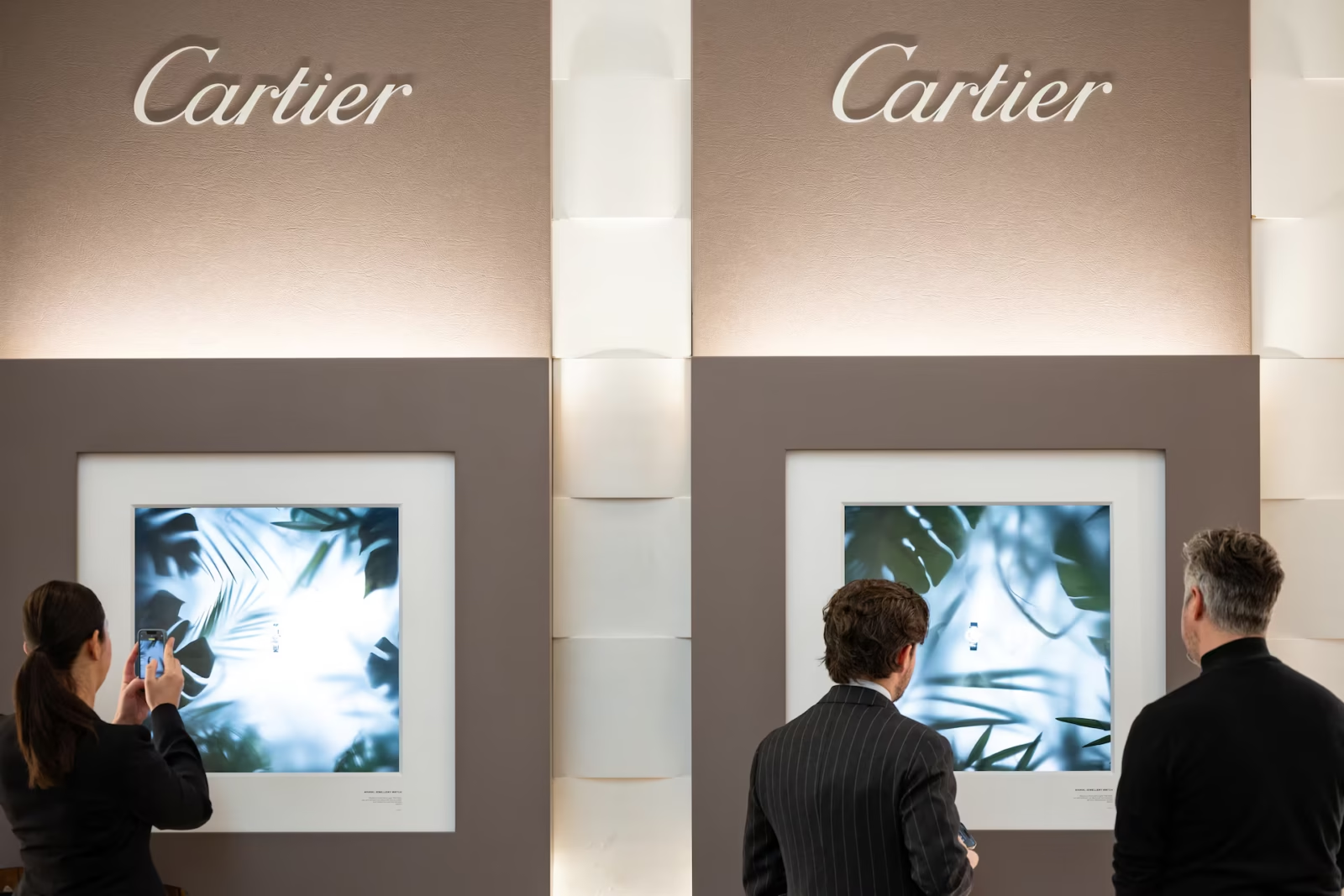
1. Corporate moves | Richemont takes a major step towards succession. The owner of Cartier, Van Cleef & Arpels, Vacheron Constantin, IWC, Piaget and Jaeger-LeCoultre has today appointed Anton Rupert, son of Johann Rupert, as non-executive co-deputy chairman, effective immediately. Anton will focus on strategic product and communications matters, while fellow co-deputy chairman Bram Schot will oversee governance. Richemont itself describes the appointment as part of its long-term succession planning. In an industry where some of the world’s largest luxury empires remain heavily influenced by founding families, succession is becoming one of the sector’s most important strategic questions.
2. Luxury automotive | McLaren invests £450 million and creates 1,000 jobs while the British premium automotive industry restructures. McLaren’s expansion represents the opposite side of the cost-cutting currently affecting parts of the European automotive sector. The company is investing heavily in its Woking technology and manufacturing capabilities as it seeks to expand engineering, R&D and future product development. The strategic contrast is fascinating: premium automotive manufacturers must simultaneously protect heritage, finance electrification and software, respond to Chinese competition and maintain the extreme product quality expected by affluent customers. The next decade will reveal which marques can turn technological disruption into a new form of desirability rather than simply treating it as an industrial cost.
3. Markets | Inditex offers luxury an uncomfortable lesson in operational excellence. The Spanish fashion giant reported today that first-half sales increased 7.6% to €19.755 billion, while net profit rose 6.8% to €2.98 billion. Europe excluding Spain generated more than €10 billion in first-half sales, while the group continues to optimise rather than indiscriminately expand its store network. The comparison with luxury groups should not be taken literally — their economics, positioning and scarcity models are fundamentally different — but Inditex demonstrates something luxury executives cannot ignore: speed, logistics, data, inventory discipline and the ability to respond rapidly to consumers can create enormous value behind the scenes.
4. Retail + India | Off-White strengthens its presence in one of luxury’s most important future markets. The expansion of contemporary luxury and streetwear in India illustrates how the country’s opportunity is moving beyond traditional jewellery and the established European maisons. India’s increasingly affluent, younger urban consumers are becoming relevant to fashion, accessories, watches, beauty and contemporary cultural brands. The strategic opportunity is not simply selling European luxury to India, but understanding how Indian consumers may eventually influence global luxury culture itself.
5. Retail | Tommy Hilfiger is turning the store into a residence. The brand’s emerging retail language illustrates a broader transformation across premium retail: warmer interiors, furniture, art, hospitality references and spaces that feel more like private residences or clubs than conventional stores. The objective is no longer merely to display merchandise efficiently. Physical retail must now provide something ecommerce cannot replicate: atmosphere, human interaction, discovery and a sense of belonging. The luxury store is gradually becoming a hospitality product.
6. Fashion | New York Fashion Week prepares for a major American heritage revival. The new season is putting established American names back at the centre of the conversation. Ralph Lauren, Coach and Tommy Hilfiger are particularly interesting because they are demonstrating that heritage can attract younger consumers when familiar codes are intelligently refreshed. Coach’s Tabby and Ralph Lauren’s renewed knitwear and polo propositions have found strong resonance among younger customers in North America and Asia. The lesson extends well beyond American fashion: younger generations do not necessarily demand new brands; they demand new reasons to desire established ones.
7. Jewellery | New York becomes a battlefield for the American high-jewellery customer. European jewellery houses are increasingly using Fashion Week, art, celebrities and cultural programming to build relationships with wealthy American clients. The shift is important because fine and high jewellery are moving closer to fashion and personal identity. A major necklace or bracelet is no longer necessarily positioned only as an object for formal occasions; it can become part of a client’s personal style, collection and long-term wealth narrative. The United States remains crucial to this strategy as luxury groups increasingly concentrate on clients capable of making very high-value purchases.
8. Haute horlogerie | Vacheron Constantin pushes the wristwatch towards the territory of art. The maison’s Métiers d’Art work demonstrates what can happen when traditional watchmaking absorbs techniques from completely different creative disciplines. Feathers, crystal, embroidery, paper, wood and other materials can transform a dial into an artistic surface rather than merely a functional component. This represents an important direction for the highest tier of watchmaking: the further a mechanical watch moves away from industrial reproducibility, the easier it becomes to justify its position as a collectible cultural object rather than simply an expensive instrument for telling time.
9. Premium beauty | Sephora continues to benefit from the expanding territory between mass and prestige. One of beauty’s most interesting growth areas is increasingly the space sometimes described as masstige or accessible prestige: products combining sophisticated formulations, attractive packaging, strong digital storytelling and premium retail environments without necessarily carrying traditional luxury prices. At the same time, today’s beauty news shows brands increasingly blending wellness, celebrity investment and product innovation; Estée Lauder is also adjusting brand leadership as competition intensifies. Beauty may therefore remain one of the most dynamic laboratories for understanding how younger consumers redefine what “premium” actually means.
10. Premium travel | Emirates is effectively creating a new territory between Premium Economy and Business Class. Emirates has unveiled what it describes as the world’s first electrically powered Premium Economy seat with a full-height adjustable privacy screen. The new Airbus A350 cabin contains only 28 Premium Economy seats in a 2-3-2 configuration, giving passengers greater control over comfort and personal space. This matters because Premium Economy is evolving beyond “Economy with extra legroom.” Airlines are discovering an attractive customer who may not pay Business Class fares but will spend considerably more for privacy, better service, comfort and reduced friction. That space could become one of aviation’s most profitable premium battlegrounds.
11. Hospitality | Luxury hotels increasingly compete through everything surrounding the room. The direction of the hospitality market is increasingly clear: the suite remains important, but restaurants, bars, wellness, private clubs, retail, social spaces and personalised service determine how long guests remain within the hotel ecosystem and how much they spend. Recent developments such as Aman’s plans for its first South Korean property in Seoul and Bulgari Hotel Milano’s expansion of its restaurant proposition reinforce the continuing convergence between hospitality, gastronomy, wellness and lifestyle.
The big picture on September 9
Today’s developments reveal a powerful underlying idea: luxury is moving from competing through products to competing through ecosystems. Richemont is thinking about who will protect and develop an entire portfolio of maisons for the next generation. Automotive manufacturers must combine heritage with technology. Fashion companies increasingly require world-class data and logistics behind the glamour. Jewellery houses are connecting themselves with fashion, culture and art. Watchmakers are transforming objects into collectible craftsmanship. Beauty is erasing the old boundaries between mass, prestige and wellness. Airlines are creating entirely new tiers of premium experience.
The luxury company of the future will therefore need to operate with two apparently contradictory personalities. In front of the customer, it must remain emotional, human, rare and culturally desirable. Behind the scenes, it will need to become increasingly sophisticated in technology, data, logistics, customer intelligence and operational efficiency.
That combination may become one of the defining competitive advantages of luxury towards 2030.
Discover more from LUXONOMY
Subscribe to get the latest posts sent to your email.