Luxury & Premium Daily Radar — September 12, 2026


The luxury market is delivering an increasingly clear message: high-income consumers continue to spend, while aspirational customers are becoming far more selective; China is demonstrating that cultural affinity can matter as much as brand power; the United States is becoming one of the industry’s priority growth territories; physical retail is regaining relevance when transformed into experience; and travel, beauty, fashion and hospitality are evolving towards increasingly integrated ecosystems. At the same time, elevated energy prices and interest rates are creating additional pressure on margins and premium demand.
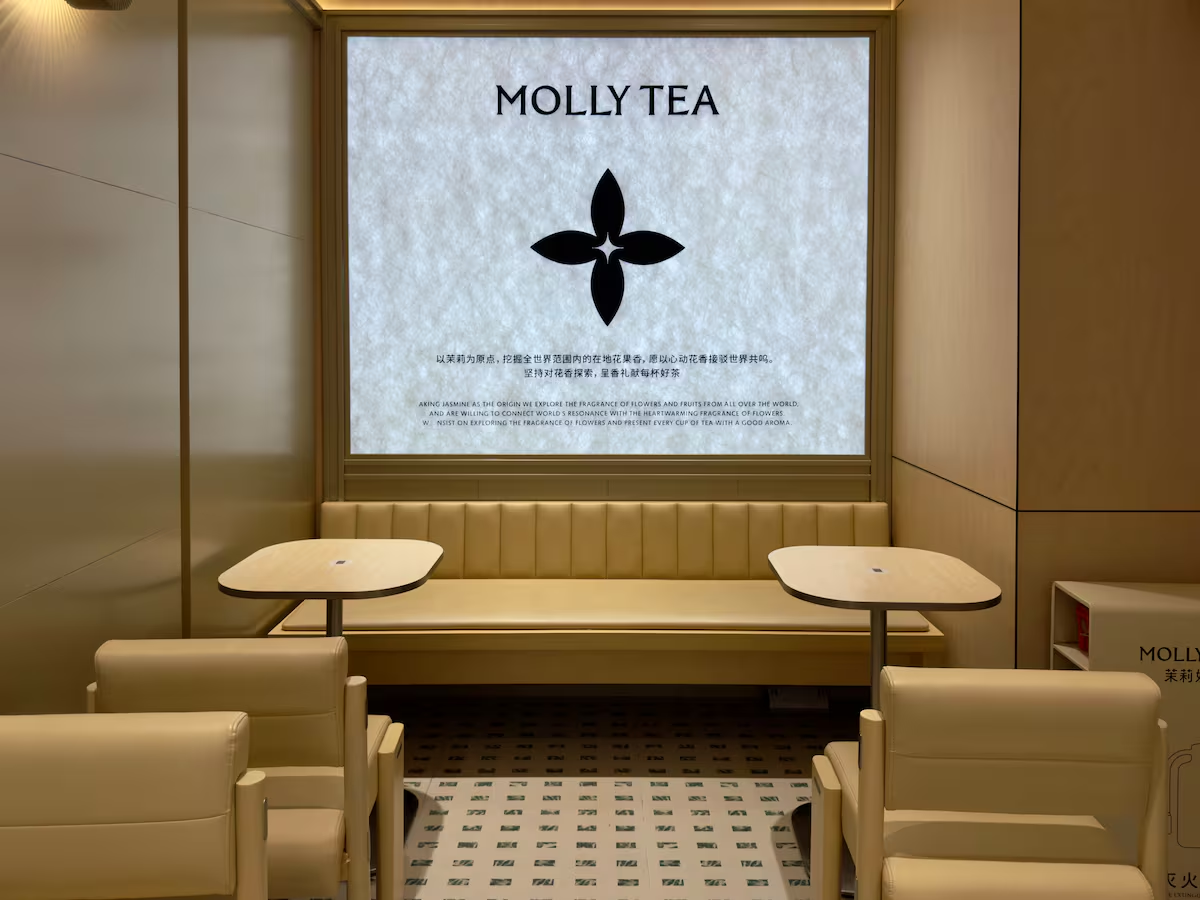
Louis Vuitton is discovering in China that winning a legal battle can come at a commercial cost. Following the maison’s dispute with local tea chain Molly Tea over floral motifs considered similar to Vuitton’s monogram, estimates from JL Warren Capital indicate that Louis Vuitton’s sales in China fell by approximately 30% in July and between 20% and 25% in August. China’s weaker economy explains part of the decline, but the social-media reaction surrounding the dispute has introduced a much more complicated cultural dimension. Louis Vuitton may have prevailed legally, yet the wider debate over traditional Chinese visual symbols appears to have damaged some of its local goodwill. The lesson extends far beyond one company: in China, protecting intellectual property is no longer enough; global maisons must also protect cultural legitimacy and social perception.
Meanwhile, Inditex is turning the United States into its next major growth frontier, with Zara opening or expanding in Denver, Phoenix and Pittsburgh while Massimo Dutti and Bershka strengthen their presence in New York. The group expects to complete 20 US expansion projects by the end of 2027. What should interest luxury executives is not simply Inditex’s expansion, but how it is expanding. The company has reduced its global store count by approximately 27% since the pandemic while cutting total retail space by only around 7%, concentrating investment in larger and more productive locations. This creates an uncomfortable competitive question for luxury. Consumers who have reduced spending after years of aggressive price increases are finding increasingly sophisticated alternatives at dramatically lower prices. The real competitor to a €3,000 luxury product may not always be another €3,000 product; it can increasingly be a €200 alternative delivering strong design, experience and perceived quality.
The American market is simultaneously demonstrating that affluent consumers have not stopped spending. Bloomingdale’s comparable sales increased 11.3% in the second quarter, while Bluemercury grew 6.2%, helping Macy’s raise its 2026 outlook. The company is reducing exposure to weaker locations while increasing the importance of Ralph Lauren, Coach, watches, jewellery and other higher-margin categories. This reinforces the growing polarisation of US consumption: lower-income households remain cautious, while upper-middle-income and affluent consumers retain substantial spending capacity. The opportunity therefore appears particularly attractive for accessible premium, prestige beauty and luxury propositions where the relationship between price and perceived value remains easy to understand.
Fashion is responding to this environment partly by rediscovering its own archives. Proenza Schouler is reviving the PS1, one of the defining It bags of the late 2000s. The new PS1 Walker preserves the messenger-bag DNA of the original 2008 design while simplifying construction and introducing softer leather, with three sizes expected between approximately $1,650 and $2,590. The most revealing figure is that leather goods already represent roughly one-third of Proenza Schouler’s sales. Archives are therefore becoming more than cultural heritage: they are commercial assets capable of reducing the enormous cost and risk involved in trying to manufacture a completely new icon from zero.
New York Fashion Week reinforces exactly the same idea. Tommy Hilfiger transformed the Plaza Hotel into the setting for his return to NYFW, with Gigi Hadid opening a collection built around Prep Made Current, while Diane von Furstenberg returned to the runway after almost a decade with the wrap dress reinterpreted for a new generation. Ralph Lauren, Coach and other American names are producing similar evidence. The conclusion is becoming difficult to ignore: heritage does not need to be erased to attract younger consumers. It needs to be translated into contemporary culture.
Beauty is reaching the same conclusion through physical experience. Chanel has created an immersive Meatpacking District environment around Coco Mademoiselle Crush Absolu, while Carolina Herrera has developed The Good Girl Lab in SoHo around the tenth anniversary of Good Girl. Both concepts combine fragrance with discovery, personalisation, hospitality and additional beauty categories. The strategic evolution is important: beauty companies are no longer thinking only about how to persuade someone to buy a bottle. They are designing an environment the consumer wants to enter, photograph, explore and remember. The transaction begins before the customer reaches the checkout; it begins when they enter the brand’s universe.
At the same time, Le Labo celebrates twenty years and offers almost the opposite lesson. Founded in 2006 by Fabrice Penot and Eddie Roschi and owned by Estée Lauder since 2014, the company transformed Santal 33 into one of contemporary perfumery’s great cultural phenomena without relying on the traditional visual vocabulary of luxury. Less visible branding, controlled distribution, authorship, ritual, perceived craftsmanship and extraordinary consistency created desirability. In a beauty market overwhelmed by launches, Le Labo demonstrates that maintaining a recognisable personality for twenty years can create more value than constantly producing novelty.
High jewellery is also moving beyond the boutique. Boucheron presented Lierre de Paris in Central Park’s Conservatory Garden, surrounding diamond pieces with Per Se gastronomy, live music and nature. The broader strategy is increasingly visible across Boucheron, Bulgari and other maisons: high jewellery is being inserted into fashion, art, gastronomy, celebrity culture and entertainment. The objective is to make jewellery part of the client’s lifestyle rather than something reserved for formal occasions. For the UHNW consumer, the product, access, social environment and memory surrounding the acquisition are progressively becoming part of the same luxury proposition.
Watchmaking continues to reward technical identity. Tudor has revived North Flag as a GMT, while M.A.D.Editions by MB&F is bringing Vincent Calabrese’s wandering-hours architecture to the M.A.D.3. Although they occupy very different positions in the market, both illustrate the same shift: sophisticated watch buyers increasingly want a technical story and recognisable architecture rather than another dial colour built around an existing commercial formula. As watch knowledge expands through collector communities and the secondary market, being understood by the right 10,000 people can increasingly matter more than being recognised by ten million.
Luxury automotive is undergoing an equally profound transformation. BMW’s latest 7 Series and electric i7 place growing emphasis on cabin technology, including Panoramic iDrive, a 17.9-inch central display, a 14.6-inch passenger screen and the extraordinary 31.3-inch 8K Theatre Screen for rear passengers. The strategic direction is more important than the screen dimensions. In flagship automobiles, competitive advantage is progressively shifting from cylinders and horsepower towards software, entertainment, silence, privacy, connectivity and the rear-passenger experience. The luxury automobile is gradually becoming a private digital lounge.
Hospitality provides another example of an established model being challenged. Casa Nizuc, a Tribute Portfolio Resort, has opened in Punta Nizuc, Cancún, with 235 rooms, five speciality restaurants, three pools, spa and beachfront access. Its most interesting business characteristic is that it operates under a European Plan rather than following the all-inclusive structure dominating much of Cancún. Marriott is effectively testing whether the destination has matured sufficiently to attract guests prepared to pay separately for gastronomy, wellness, experiences and personalised service. If successful, it could accelerate the development of a new premium hospitality model across the Mexican Caribbean: less package, more choice; less standardisation, more individual spending opportunities.
Premium travel is simultaneously becoming more integrated. Delta and Hyatt have announced a long-term relationship between SkyMiles and World of Hyatt, allowing eligible elite members to connect benefits across flights and hotel stays. This is precisely where the sector is heading. Airlines, hotels, credit cards, airport lounges and mobility providers increasingly want to recognise the same affluent customer across the entire journey rather than treat each transaction independently. The prize is not simply the next flight or hotel booking; it is a greater share of the customer’s total travel expenditure and, ultimately, their lifetime value.
The LUXONOMY view
The underlying message is increasingly clear: luxury is no longer a homogeneous market. Bloomingdale’s can grow at double-digit rates while some consumers abandon handbags they consider excessively expensive. Louis Vuitton can possess extraordinary global authority and still encounter cultural resistance in China. Inditex can capture customers who previously allocated more money to luxury. Proenza Schouler can create future growth by returning to its archives. Boucheron can transform jewellery into experience. Chanel can turn fragrance into a physical destination. BMW can convert the rear seat into a technology platform. Marriott can challenge the dominant business model of an entire destination.
The central question for the next luxury cycle will therefore not simply be who can raise prices. It will be who can justify every additional dollar, euro or pound through product, experience, service, recognition, culture, scarcity or time saved. That is where the distinction between genuine luxury and merely expensive products will become increasingly visible.
Discover more from LUXONOMY
Subscribe to get the latest posts sent to your email.