Luxury rewrites the rules: fewer customers, greater value and a global battle to own the relationship with the world’s wealthiest consumers


September 8, 2026 offers an unusually clear picture of the transformation taking place across the global luxury industry. From eyewear and automotive to hospitality, aviation, retail, watchmaking, jewellery and beauty, apparently unrelated developments are converging around the same strategic reality: luxury companies are entering an era in which simply reaching more consumers matters less than understanding, serving and retaining the customers who generate the greatest value. EssilorLuxottica is facing pressure to rethink strategy after losing more than half of its stock-market value in recent months; Jaguar Land Rover is preparing to cut around 4,000 jobs while continuing to invest heavily in electrification and technology; Nammos has transformed its Mykonos lifestyle identity into a complete resort proposition on the Saudi Red Sea; and Qantas is putting selected First Class passengers into Mercedes-Maybachs because it has understood that the wealthiest traveller increasingly pays to eliminate friction, not merely to obtain a better seat.
These developments arrive as the luxury market becomes increasingly polarised. The industry spent much of the previous decade expanding distribution, acquiring aspirational consumers, increasing digital reach and using global scale as one of its principal measures of success. The next cycle looks different. The most valuable customers are becoming more important, service is becoming more individualised and the relationship between a client and the person representing a brand can sometimes become as powerful as the relationship with the brand itself. The competitive question is therefore changing from How many customers can we acquire? to something far more sophisticated: How much value can we create around each of the customers we most want to keep?
EssilorLuxottica shows why scale alone is no longer enough
Few companies illustrate the new challenge better than EssilorLuxottica. The Franco-Italian giant controls an extraordinary ecosystem spanning Ray-Ban, Oakley, optical technology, retail, lenses and increasingly smart eyewear and medtech. Yet Leonardo Maria Del Vecchio, son of founder Leonardo Del Vecchio, has publicly called for a new strategy after the group lost more than half of its stock-market value in recent months. The intervention reflects a deeper debate about what EssilorLuxottica should become as traditional eyewear, healthcare, artificial intelligence, wearable computing and connected devices increasingly converge.
This matters well beyond eyewear. Luxury groups have traditionally created value by owning desirable brands and expanding their distribution. Future winners may need to do something considerably more complex: combine brand equity with technology, data, services and long-term customer relationships. Ray-Ban Meta already demonstrated that eyewear can become a technology platform without necessarily abandoning fashion or desirability. The next challenge is turning that technological capability into a coherent ecosystem rather than allowing innovation to fragment the company’s identity.
The same pressure can increasingly be seen across the wider luxury market. Investors are becoming more selective about companies that possess scale but lack a sufficiently convincing growth narrative. Brand recognition remains important, but recognition alone does not guarantee pricing power, loyalty or profitability. The market increasingly wants evidence that a luxury company knows where future demand will come from and possesses the organisational capabilities to capture it.
Jaguar Land Rover faces the brutal economics of reinventing luxury automotive
The pressure is equally visible in luxury automotive. Jaguar Land Rover has announced plans to cut nearly 10% of its global workforce, approximately 4,000 jobs, as part of a turnaround programme targeting £1.7 billion in savings over the next two years. At the same time, JLR intends to continue investing between £15 billion and £18 billion over five years in electrification, digital capabilities and manufacturing upgrades. The contradiction is only apparent: the company must become leaner at precisely the moment when developing the next generation of luxury vehicles requires extraordinary capital.
This is one of the defining problems facing European premium automotive groups. Chinese manufacturers are accelerating product development, software integration and electrification while customers increasingly expect their vehicles to combine craftsmanship with digital sophistication. A luxury car can no longer succeed through leather, performance and badge prestige alone. Software quality, interfaces, connectivity, autonomous capabilities and the surrounding service ecosystem are becoming part of what determines whether a vehicle feels genuinely premium.
For Range Rover, Defender and Jaguar, protecting heritage while radically changing underlying technology will be essential. The brands cannot simply imitate technology companies, because much of their value comes from history and emotional recognition. But neither can they rely on that history as protection against competitors able to deliver superior digital experiences. Luxury automotive is entering a difficult period in which tradition must remain visible while almost everything underneath it changes.
Nammos proves that a lifestyle brand can become an entire hospitality ecosystem
At the opposite end of the spectrum, Nammos provides one of the clearest examples of how a powerful lifestyle identity can be extended into entirely new categories. On September 7, Nammos Resort AMAALA welcomed its first guests, marking the evolution of a brand originally associated with the beach-club culture of Mykonos into a complete international resort business. The new property at Triple Bay on Saudi Arabia’s Red Sea coast includes 110 rooms, suites and villas together with 20 branded residences, while the signature Nammos Restaurant occupies its own private island.
What Nammos is really monetising is not hotel inventory. It is cultural recognition. Guests already understand what the name promises: social energy, dining, music, Mediterranean glamour and a particular style of leisure. Hospitality allows that identity to become a 24-hour experience rather than a few hours spent at a restaurant or beach club.
The economic possibilities expand dramatically once a lifestyle brand enters hospitality. Rooms generate accommodation revenue; restaurants capture local as well as hotel guests; wellness adds additional spending; branded residences transform brand equity into real-estate value; and future properties allow the same customer community to move between destinations without leaving the brand ecosystem.
Nammos is already planning additional hotels and resorts in Montenegro, the Maldives and Egypt. This is precisely the type of expansion likely to become more common across luxury: brands moving from selling a category to owning a lifestyle territory.
Qantas understands that the richest passenger is really buying time
Perhaps the smallest development of the day contains one of the biggest lessons. Qantas is trialling a private chauffeured transfer at Sydney Airport for selected First Class customers connecting between the international and domestic terminals. Instead of using the conventional terminal transfer, invited passengers will travel airside in a Mercedes-Maybach, accompanied by a Qantas host. The trial will operate from September to November.
The reason is especially revealing. Research conducted by Qantas indicates that First Class customers value speed, simplicity and maximising the amount of time they can spend in the lounge rather than in transit between terminals.
That sentence could almost become a manifesto for the next generation of luxury.
The passenger is not really buying a Maybach ride. The customer is buying back minutes of life, reduced uncertainty and relief from inconvenience. The car is simply the physical mechanism through which that value is delivered.
Luxury travel increasingly works this way. Fast-track immigration, private terminals, aircraft-side transfers, chauffeur services, personal concierges, baggage handling and seamless hotel arrivals all monetise the same scarce asset: time without friction.
For UHNW consumers, this can be worth substantially more than an additional physical product. A wealthy traveller does not necessarily need another amenity kit. They may, however, happily pay thousands more to remove waiting, queues, uncertainty and unnecessary transitions from a journey.
This is why the premium travel ecosystem is expanding far beyond First Class seats. Airports, airlines, hotels, private aviation companies and luxury transport providers are all competing for the same opportunity: designing an end-to-end journey in which inconvenience progressively disappears.
Retail is becoming less about square metres and more about relationship
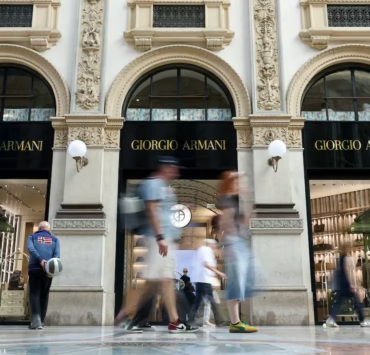
The same transformation is happening in physical retail. Luxury brands continue opening boutiques in high-value destinations such as Palm Beach, Macao and other concentrations of international wealth, but the strategic logic has changed. The objective is no longer simply to maximise store count. A boutique increasingly functions as a clienteling centre, private hospitality space, cultural platform and physical expression of the brand.
Palm Beach is a particularly interesting example because its growing concentration of affluent residents and seasonal UHNW visitors makes it possible for luxury brands to build relationships with customers who possess both high spending power and substantial lifetime value. Macao offers another version of the model by combining hospitality, gaming, tourism, gastronomy and shopping inside an ecosystem capable of generating multiple luxury transactions during a single visit.
This explains why tomorrow’s most valuable retail metrics may be different from yesterday’s. Footfall remains useful, but knowing who entered, who returned, what they already own, which adviser they trust and what they are likely to want next can be considerably more valuable than measuring the raw number of people passing through a store.
The luxury boutique is therefore evolving from point of sale to relationship infrastructure.
The most dangerous employee to lose may be the person who knows your best customers
This becomes especially important in watches, jewellery and other high-ticket categories where relationships can last for years. A top sales adviser may understand a collector’s existing portfolio, family milestones, preferred complications, allocation history, future wish list and tolerance for different price levels.
That knowledge creates enormous commercial value.
The danger for luxury companies is that customers can become loyal to the adviser before they become loyal to the institution. When that adviser moves to another retailer or maison, part of the client portfolio may move as well.
The implication is uncomfortable but unavoidable: luxury brands do not automatically own their customer relationships simply because they own the CRM system.
A database may contain transaction history, but the adviser can hold something far more valuable — trust.
The strongest luxury companies will therefore need to find ways to institutionalise relationships without making them impersonal. Customer knowledge must be shared appropriately across the organisation; service standards need to survive employee departures; CRM needs to capture preferences rather than merely purchases; and brands must provide enough unique value that the relationship cannot easily migrate with a single individual.
Clienteling is moving from a sales technique to a strategic corporate capability.
Jewellery shows why technology and craftsmanship are no longer opposites
The jewellery sector is experiencing a parallel transformation. Vicenzaoro’s growing focus on additive manufacturing, digital production and advanced 3D-printing technologies demonstrates that some of the most traditional luxury industries are embracing tools that would once have appeared incompatible with craftsmanship.
But automation does not necessarily eliminate artisanship. Used intelligently, it can allow designers to create geometries that would be extraordinarily difficult to manufacture using traditional techniques alone, reduce prototyping time, improve precision and increase the economic viability of personalised production.
This may become particularly important as high-value customers demand more bespoke work. The old industrial model needed volume because customisation was expensive. Advanced manufacturing can change that equation.
The result could be an interesting paradox: technology may help luxury become less standardised.
Rather than replacing craftsmanship, digital fabrication can concentrate human expertise on finishing, setting, interpretation and artistic decision-making while machines handle aspects of production where consistency and precision create greater value.
Beauty continues to discover that storytelling can turn fragrance into collectability
Beauty offers another variation on the same theme. Premium fragrance increasingly operates less like traditional cosmetics and more like a cultural and collectible category. Houses such as Hermès and Guerlain are building fragrances around geography, ingredients, perfumer authorship, bottle design and recognisable collections.
This matters because storytelling changes the economics of the product. A fragrance purchased only because it smells pleasant competes with thousands of alternatives. A fragrance connected to a maison, a perfumer, a place, an artistic universe and a collection becomes something richer: it can be gifted, displayed, collected and repurchased as part of an evolving personal ritual.
Luxury beauty increasingly understands that the bottle is only one layer of the value proposition. The real product can include narrative, ritual, identity and memory.
Luxury’s next battle is not for reach. It is for ownership of the customer relationship
Put all these developments together and a much larger transformation appears.
EssilorLuxottica is being forced to consider how brands, technology and healthcare fit together. Jaguar Land Rover must dramatically reduce costs while simultaneously funding the technologies required to remain desirable. Nammos is transforming lifestyle recognition into hotels, residences, dining and wellness. Qantas is using a Maybach to remove fifteen minutes of inconvenience. Retailers want to know their VICs better. Watch and jewellery companies increasingly depend on advisers capable of maintaining deep personal relationships. Beauty houses are turning products into collectible cultural objects.
Different industries. The same economic logic.
Luxury is moving from selling products to controlling high-value relationships.
That changes almost every important management question. Customer acquisition matters, but customer lifetime value matters more. A flagship matters, but what it learns about clients matters more. A hotel room matters, but the ecosystem surrounding the guest matters more. A watch matters, but access to the right watch matters more. A First Class seat matters, but eliminating every inconvenience before and after the flight matters more.
The great luxury groups of the previous era were built partly by aggregating brands.
The great luxury platforms of the next era may be built by aggregating knowledge, access, services and relationships around the world’s highest-value consumers.
There is also a fundamental shift in scale. The most profitable future may not always belong to the company capable of reaching the largest possible audience. Increasingly, it may belong to the organisation capable of creating extraordinary value around a smaller number of extraordinarily valuable people.
The luxury industry has spent years talking about personalisation. What comes next is deeper.
It is recognition: knowing who the customer is before they have to explain themselves.
It is anticipation: understanding what they might need before they request it.
It is continuity: allowing their preferences to follow them across stores, hotels, destinations and channels.
It is access: providing experiences and products unavailable to the wider market.
And it is time: removing the friction that wealthy consumers increasingly regard as one of the greatest costs in their lives.
That may become the defining battle of luxury towards 2030.
The question will no longer simply be who sells the most luxury.
It will be who owns the deepest relationship with the people who buy it.
MBA in Luxury Management
The luxury industry is entering a new era in which strategy, customer intelligence, retail, hospitality, technology, pricing and new business models are becoming inseparable. Tomorrow’s luxury leaders will need to understand not only brands, but the entire ecosystem surrounding the world’s most valuable consumers.
Discover the MBA in Luxury Management at LUXONOMY University
Discover more from LUXONOMY
Subscribe to get the latest posts sent to your email.