Luxury is entering a new era: Armani faces its future, 1.3% of watches drive 75% of growth, and premium consumers increasingly pay for time, rarity and lasting value


September 4, 2026 brings four stories that, when viewed together, explain better than almost any industry report where global luxury is heading. Armani is entering the most delicate chapter in its fifty-year history, with a potential partial sale that could ultimately reshape the ownership of one of the world’s last major independent luxury houses. Swiss watchmaking is discovering that 75% of its growth in value is being generated by watches representing just 1.3% of total units sold. Global searches for First and Business Class flights have almost doubled in a single year. And houses such as Cartier, Bulgari and Buccellati are transforming certain handbags into objects that increasingly resemble fine jewellery rather than conventional leather goods. Four apparently unrelated developments point in the same direction: luxury is becoming less dependent on volume and increasingly concentrated around scarcity, heritage, comfort, knowledge, personalisation and customers willing to pay considerably more for what they perceive as truly exceptional.
Who will buy Armani?
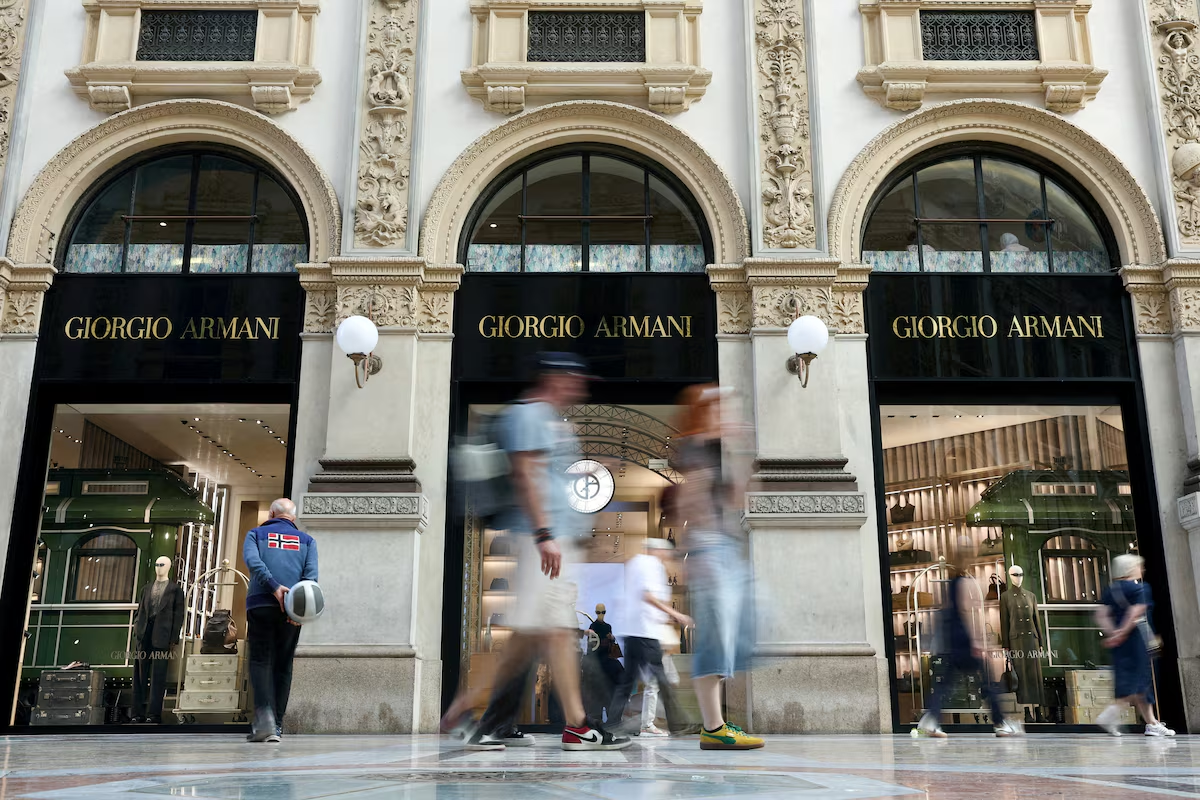
One year after the death of Giorgio Armani, the company he built over half a century is entering a phase that could permanently alter the landscape of European luxury. The designer’s will stipulated that an initial 15% stake in Giorgio Armani S.p.A. should be sold within 12 to 18 months of his death, potentially opening the door to a subsequent controlling transaction or even an IPO. Reuters currently places the company’s potential valuation at approximately €5 billion to €7 billion, with Rothschild acting as financial adviser. Three global groups with existing relationships with Armani have been directly associated with the process: LVMH, L’Oréal and EssilorLuxottica.
The potential transaction is extraordinary because Armani represents almost the opposite of the consolidation that has defined luxury over recent decades. While numerous historic maisons eventually became part of LVMH, Kering, Richemont or other major groups, Giorgio Armani preserved control of his company throughout his life and made independence part of its corporate identity. That independence must now inevitably be reconsidered. The company closed 2025 with approximately €2.2 billion in sales, down 2.8%, while its licensing agreements with L’Oréal and EssilorLuxottica remain exceptionally valuable assets. The beauty and eyewear businesses linked to those relationships generate close to €2 billion combined, helping to explain why both partners are natural candidates in any future ownership structure.
The key question is therefore not simply who could buy Armani, but what kind of Armani should exist ten or twenty years from now. LVMH could provide enormous global scale, prime real estate expertise, retail capabilities, capital and one of the world’s most sophisticated luxury infrastructures. L’Oréal understands the brand deeply through beauty and fragrance. EssilorLuxottica has a strategic relationship through eyewear and possesses substantial financial strength. Armani’s succession plan itself leaves open several possible paths, including an eventual public listing. This is why the process is likely to become one of the most closely watched corporate stories in luxury over the coming months.
There is an even deeper issue. Buying Armani does not simply mean acquiring a fashion label. It means acquiring fifty years of aesthetic codes, extraordinary global recognition, distribution, licensing businesses, hospitality activities, real estate, celebrity relationships and a unique position in the history of Italian fashion. The challenge will be to improve the economic performance of those assets without damaging precisely what makes them valuable. Any future owner will face one of the hardest challenges in luxury: making Armani grow without making Armani feel like something else.
The figure reshaping watchmaking: 1.3% of volume generates 75% of growth
While fashion considers how to reorganise historic giants, Swiss watchmaking is discovering something even more radical: it may no longer need to sell more watches in order to grow. One of the most revealing figures emerging around Geneva Watch Days 2026 is that during the first half of the year, approximately 75% of growth in value came from watches representing just 1.3% of total volume. Swiss watch exports remained broadly stable at around CHF 12.2 billion while units increased by 2.3%, yet the real economic expansion has been concentrated at the very top of the market.
The figure explains much of what is happening around Geneva Watch Days. Brands capable of selling extremely expensive, limited, technically complex or highly collectible pieces are proving far more resilient than many companies positioned in the middle of the market. Rolex, Cartier and Omega retain considerable strength, while ultra-high-end and independent manufacturers such as F.P. Journe continue to benefit from increasing collector interest. By contrast, certain price segments between CHF 25,000 and CHF 50,000 have experienced considerably greater pressure.
We are witnessing a powerful polarisation. A consumer who simply wants a very good watch can choose from hundreds of alternatives and is increasingly sensitive to price. A collector pursuing an exceptional watch behaves very differently. That buyer is acquiring provenance, movement architecture, the identity of the watchmaker, technical difficulty, annual production numbers, history, access and the future potential of a collection. The economic decision can no longer be understood purely through the functional utility of the product.
Knowledge has therefore become a new form of luxury. A watch produced in a few dozen examples can be considerably more desirable to certain clients than another recognised by millions of people. The more knowledgeable the buyer becomes, the more value they may place on something the wider market does not yet understand. The result is an apparent business paradox: producing less can enable a company to generate more value.
The geography of watchmaking is changing as well. The United States has consolidated its position as the leading export market for Swiss watches, India is rapidly gaining importance and China has lost some of the extraordinary influence it held during the previous cycle. At the same time, the secondary market continues to mature, supported even by official certified pre-owned programmes from houses such as Rolex and Audemars Piguet. The watch is increasingly becoming a hybrid category in which consumption, collecting, resale and preservation of value coexist.
First and Business Class searches rise 99%: the new luxury is buying time
The third development comes from a completely different industry but follows exactly the same logic. Trip.com has reported that global searches for First and Business Class flights increased 99% year on year during the first half of 2026. Searches for five-star hotels rose 57%. An even more revealing figure sits behind those numbers: bookings for fully customised travel through its custom-tour services increased by more than 600% year on year.
For decades, luxury was primarily defined through visible objects: cars, watches, jewellery, handbags, homes and fashion. The growth of premium travel demonstrates that an increasing share of affluent consumer spending is shifting towards something far less tangible: comfort, reduced friction, privacy and control over personal time.
A First Class seat does not necessarily get a passenger to their destination much faster than an Economy seat. Its real product is different: space, rest, priority, tranquillity, privacy, personal attention and the removal of countless small inconveniences associated with travel. For someone whose time carries a high economic or personal value, paying thousands more can become an entirely rational decision.
The same principle explains the growth of personalised travel. Customers at the highest levels of travel loyalty programmes increasingly want individually designed itineraries, continuous assistance and services capable of resolving needs before, during and after a journey. Demand is particularly strong across mainland China, Hong Kong and Singapore.
There is also an important generational dimension. Younger affluent consumers are increasingly prioritising experiences, concerts, wellness, travel and gastronomy alongside — and sometimes ahead of — traditional physical luxury goods. Luxury experiences no longer appear only after someone has spent decades accumulating wealth. They are becoming part of how younger generations choose to allocate disposable income and express identity.
The new luxury is therefore beginning to sell something no factory can manufacture in unlimited quantities: quality time. Avoiding a queue. Sleeping properly during a flight. Having a private transfer waiting immediately after landing. Receiving an itinerary designed around individual preferences. Accessing a beautiful environment without crowds. Having a problem solved without asking twice. Extreme convenience could become one of the largest premium markets of the next decade.
When a handbag stops being fashion and starts becoming jewellery
The fourth trend comes from the opposite end of the spectrum: the physical object. Yet even here, the traditional boundaries between luxury categories are disappearing. Cartier, Bulgari, Buccellati and other historic houses are increasingly exploring the territory of jewelled handbags — pieces created using materials, craftsmanship and aesthetic codes traditionally associated with fine and high jewellery.
Cartier has reinforced this movement through its Soir collection, in which evening bags and small objects incorporate precious materials and references directly connected with the maison’s jewellery universe. Bulgari is expanding its leather-goods proposition under the creative direction of Mary Katrantzou, transferring colours, motifs and visual languages from jewellery into handbags. Buccellati, meanwhile, possesses an extraordinary archive from which historical techniques and decorative references can be translated into exceptionally elaborate contemporary accessories.
The commercial opportunity is compelling. Both handbags and jewellery are expected to outperform apparel growth over the coming years, and both categories provide luxury companies with attractive margins, strong recognition and opportunities to recruit new customers. When the two categories converge, however, something even more interesting emerges. The handbag no longer competes solely through leather, logo or silhouette. Precious stones, metals, specialist craftsmanship and extremely limited production can move it into a completely different economic territory.
The result can become closer to a collectible object than a seasonal accessory. A conventional handbag is exposed to fashion cycles. A genuine jewelled object can aspire to remain relevant for decades, be inherited, displayed, acquire provenance and potentially participate in some of the same economic dynamics already visible in watches, jewellery, historic automobiles and art.
This evolution is particularly relevant at a time when parts of the market are showing fatigue with repeated price increases for conventional luxury handbags. Raising prices without proportionally increasing design quality, scarcity, craftsmanship or cultural relevance has limits. But when the product genuinely changes in nature and approaches the territory of high jewellery, the entire conversation around price changes with it.
What is really happening: less volume, much more value
Armani, high watchmaking, First Class travel and jewelled handbags appear to belong to completely different worlds. In reality, they reveal the same transformation.
Armani is potentially worth billions not simply because it sells clothing, but because it owns fifty years of cultural capital that another organisation could monetise for decades. Just 1.3% of watches are generating 75% of value growth because certain consumers will pay extraordinary premiums for rarity, knowledge and collectability. First and Business Class searches are rising 99% because affluent customers are increasingly prepared to pay for time, privacy and comfort. Cartier and Bulgari are transforming handbags into jewellery because genuinely elevating the product allows a brand to move beyond conventional price competition and towards the territory of lasting value.
Luxury is gradually shifting from selling expensive products to creating exceptionally valuable assets and experiences for specific customers.
This fundamentally changes the rules of the business. The traditional obsession with expanding distribution, increasing SKU counts, multiplying stores and reaching millions of consumers may increasingly give way to far more selective strategies. Fewer customers, but deeper knowledge of them. Fewer products, but more exceptional ones. Less distribution, but greater control. Fewer promotions, but stronger margins. Fewer anonymous transactions and much longer relationships.
The figures emerging today offer perhaps one of the clearest definitions of luxury towards 2030: the future does not necessarily lie in selling more. It lies in making certain people willing to pay substantially more because what they receive gives them something extremely difficult to find elsewhere: time, access, identity, knowledge, comfort, culture or rarity.
That may ultimately become the defining distinction between premium and true luxury over the coming years. Premium improves what already exists. True luxury increasingly seeks to provide something that is exceptionally difficult to replace.
MBA in Luxury Management
Understanding the new luxury requires going far beyond brands and products. Strategy, emerging consumer behaviour, hospitality, retail, hard luxury, technology, international markets and new business models are redefining an industry entering an entirely new era.
Discover the MBA in Luxury Management at LUXONOMY University
Discover more from LUXONOMY
Subscribe to get the latest posts sent to your email.