economy

French cosmetics powerhouse L’Oréal has reached a landmark agreement to acquire Kering’s beauty division, which includes iconic fashion houses Gucci, Balenciaga, Bottega Veneta, and Alexander McQueen, for approximately €4 billion (US $4.7 billion).

The announcement triggered a market-wide rally: LVMH shares soared as much as 14% on October 15, lifting the entire sector and adding roughly US $80 billion in market value to the STOXX Europe Luxury 10 Index, which tracks Europe’s leading luxury groups. Brands such as Hermès, Richemont, and Kering also rose between 5% and 8% in the wake of the news.

The main growth engine was Miu Miu, which delivered an impressive +29% retail sales growth in Q3, consolidating its position as one of the most dynamic brands in global luxury. In contrast, the Prada brand recorded a slight 2% decline in retail sales over the nine-month period.

On October 17, shares surged by 14 %, adding more than $20 billion in market value. In its third-quarter 2025 report, the company announced revenues of €6.87 billion, representing an 11.7 % growth at constant exchange rates — its strongest performance on record.

Record Gold Prices in India Push Festive Buyers Toward Coins and Bullion Over Jewelry.
As India enters the festival of Dhanteras, marking the beginning of Diwali, gold prices have reached an unprecedented level — exceeding ₹132,000 per 10 grams (≈ US $1,585) in certain regional markets.

Kering Nears $4 Billion Sale of Its Beauty Division to L’Oréal.
If finalized, the deal would stand among the most significant luxury transactions of 2025, redrawing the boundaries between the worlds of couture and cosmetics.

According to the official statement, the brands restricted independent retailers from setting their own prices or offering discounts, in an effort to preserve brand exclusivity and profit margins. The practice, which violates EU competition law, effectively prevented fair price competition and limited consumer choice.

French luxury retailer Galeries Lafayette will open its first Indian flagship this November in Mumbai’s historic Kala Ghoda district, marking one of its boldest international moves in years.

LVMH closed the third quarter of 2025 with revenues of €18.28 billion, reflecting a modest +1% year-on-year increase after several months of contraction.
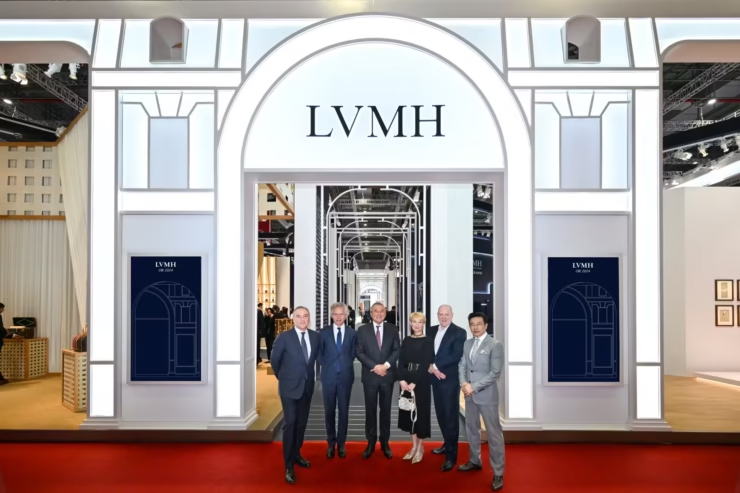
The European luxury sector is experiencing a month of contrasts. While LVMH Moët Hennessy Louis Vuitton surprised markets with a return to growth in Q3 2025, driven by a rebound in Chinese demand, the European Commission has imposed heavy fines on Gucci, Chloé, and Loewe for retail price-fixing practices.

The luxury market is entering a phase of moderate growth after several years of rapid expansion. Global luxury revenues should grow at a rate of 2 %–4 % per year between 2025 and 2027. Leather goods and jewellery will be the fastest‑growing categories (4 %–6 % per year), while high‑spending clients will generate 65 %–80 % of the growth. 2024 marked a turning point: the market remained practically flat (≈ €1.48 trillion) and personal goods declined by 2 %, while experiences (hotels, dining, travel and yachts) were the only categories to grow. China’s slowdown – where luxury sales fell 18 %–20 % in 2024 and 2025 is expected to be flat – and macro headwinds in Europe are dampening growth, although recovery could arrive in the second half of 2025.
This report delves into the figures and global trends to provide a structured analysis by segment, region and generation, as well as a review of the leading brands and companies in the sector.

The global personal luxury market appears to have reached a decisive inflection point. After nearly a decade of uninterrupted growth, analysts now predict a 5% contraction in 2025, following the modest 2% decline already recorded in 2024. The slowdown marks the end of an era of effortless expansion and signals the beginning of a new phase defined by selectivity, authenticity, and purpose.

LVMH Moët Hennessy Louis Vuitton is set to release its third-quarter 2025 revenue after the Paris stock market closes on October 14, with a live audio webcast scheduled at 6:00 p.m. CET. According to the company’s investor relations site, all related materials will be made available just before the presentation.
This update comes at a delicate time for the luxury conglomerate. The spot price of gold reached a historic high of USD 4,078 per ounce on October 13, adding margin pressure to LVMH’s Watches & Jewelry division, which includes Tiffany & Co., Bulgari, Chaumet, and TAG Heuer.

After months of stagnation, European luxury equities surged this week, driven by renewed investor optimism…

This week marked a series of strategic expansions that underscore a clear trend: the center…

This week, prosecutors in Milan requested that Tod’s, the iconic leather and footwear house founded by Diego Della Valle, be placed under temporary judicial administration following alleged labor violations by some of its subcontractors.

Miami, October 8, 2025 — Amancio Ortega, through his real estate investment arm Pontegadea, has completed the purchase of the Sabadell Financial Center in Miami for approximately $274.4 million (around €236 million). Located at 1111 Brickell Avenue, the 31-story tower stands as one of the most prominent office buildings in the city’s financial district.

A Promising Recovery for the European Luxury Sector European luxury stocks showed a strong rebound…

Giorgio Armani was, without a doubt, a legend in the world of luxury and fashion.…

The 0.01% refers to the tiny fraction of the population with the highest wealth and influence – essentially billionaires and centi-millionaires at the very top of the economic pyramid. These ultra-high-net-worth individuals live in a world where privacy is paramount and trust is a luxury commodity. In an era of hyper-connectivity, they seek refuge in private sanctuaries away from prying eyes, where they can mingle with peers on equal footing. Ultra-exclusive clubs have emerged to fulfill this need: curated enclaves offering security, like-minded company, and bespoke experiences befitting those who have everything. Beyond status symbols, these clubs serve a strategic purpose – they create an intimate environment for networking, deal-making, and socialising among the global elite, in spaces shielded from the public gaze.
The existence of such clubs reflects a simple truth: even in a digital age, the wealthiest 0.01% value exclusive physical spaces that guarantee discretion and exceptional service. These clubs are modern heirs to the gentlemen’s clubs and salons of old, updated for today’s cosmopolitan elite. They thrive because they offer something money alone can’t easily buy in the open market – a sense of belonging to an ultra-select circle. For members of this stratum, ultra-exclusive clubs are safe havens where they can be themselves among equals, form alliances, and enjoy privileges tailored to their rarefied lifestyle. In short, the 0.01% clubs exist because the world’s wealthiest crave community and experiences that are as singular as their socioeconomic position.

An eco-conscious luxury resort integrating renewable energy and wildlife conservation, illustrating sustainability as a core…

The global luxury travel map is undergoing a geographic realignment. Traditionally dominated by established destinations in Western Europe and North America, the landscape is shifting as new players rise in the Middle East, Asia, Africa, and Eastern Europe. High-growth economies and visionary governments are investing heavily to position their countries as the next elite playgrounds for affluent travellers. By 2030, destinations such as Saudi Arabia, Vietnam, Rwanda, and Montenegro are expected to compete with – and in some aspects outperform – the likes of France, Italy or the USA in attracting luxury tourism. This report provides an insight-driven analysis of these four emerging luxury tourism hubs. Each is leveraging unique strategic advantages – from giga-projects in the desert to exclusive eco-tourism and superyacht marinas – to redraw the boundaries of high-end travel. Investors and luxury operators will find these markets ripe with opportunity, albeit not without risks. The following sections examine how each country is reshaping the luxury travel landscape through national strategy, infrastructure investment, flagship projects, projected 2030 indicators, competitive positioning, and potential barriers.

India is no longer merely a “promising” market: by 2025 it has solidified its position as a pivotal axis of global luxury. With sustained GDP growth (+6.8%), an upper-middle class exceeding 180 million people, and a profoundly aspirational culture, India is attracting international conglomerates, emerging brands, and Asia’s new ultra-premium consumers.
This report analyzes the current luxury market landscape in India, the most dynamic categories (fashion, hospitality, beauty, watchmaking, automobiles), the behavior of the Indian luxury consumer, regulatory barriers, Bollywood’s influence, and the most probable scenarios through 2030.

July 2025 has marked a turning point for the global luxury industry. Financial results from…

On July 10, Thélios inaugurated a new production site in Longarone, Italy entirely dedicated to…

This report introduces The TasteMaker Index, a proprietary, data-driven metric designed to quantify the real influence of key figures on the valuation of luxury assets worldwide. Rather than focusing on obvious social media influencers alone, the index encompasses discreet power players – including high-profile collectors, family office advisors, critics, auctioneers, and foundation directors – whose tastes and decisions demonstrably sway market trends in luxury sectors.

These individuals – listed in order of influence – represent the pinnacle of luxury leadership in 2025, each with a biography reflecting their professional journey and the impact they wield in this $1.5 trillion industry.

In an increasingly volatile, technological, and aging world, luxury does not merely endure—it transforms, redefines itself, and expands. What was once a symbol of material exclusivity will become, in the coming decades, a symbolic economy deeply connected to identity, longevity, and human transcendence.

Luxonomy University, a leading international institution in online education specializing in Fashion, Luxury, and New Global Trends, announces the opening of registrations for a new edition of its flagship program: the MBA in Luxury Management, scheduled to start on September 15, 2025.
This program, completely updated and tailored to the demands of the 21st-century consumer, is designed to train future leaders of the luxury sector in an increasingly competitive, digitized, and global environment.

The brand Inter Miami CF has experienced rapid growth since its founding in 2018. In just a few years, the club has transformed from a new MLS expansion franchise to topping financial value rankings and gaining international presence. Founded by David Beckham and entrepreneur Jorge Mas, Inter Miami started with a carefully crafted brand: distinctive colors (pink and black), an elegant crest featuring entwined herons, and a cosmopolitan narrative. With its first official match in 2020, the club opted for an aspirational style that merged sports passion with the cosmopolitan lifestyle of Florida.
In this LUXONOMY Report, the brand value of Inter Miami is analyzed in depth, covering its financial evolution from its founding to the current time, the impact of Lionel Messi, comparisons with other MLS franchises, revenue from sponsorships, merchandising and ticket sales, influence on social media, public perception of the team, and the infrastructure strategy and expansion into new markets. Each aspect demonstrates how the brand has solidified its achievements and future prospects.

Morocco has positioned itself as an attractive destination for luxury real estate investment, combining exotic cultural richness with economic and political stability. The high-end market in the country encompasses exclusive residential properties—such as villas, traditional riads, and premium apartments—as well as commercial luxury assets, including boutique hotels, five-star resorts, and prime office spaces in urban centers. In recent years, positive trends in tourism, modern infrastructure, and open government policies have energized the sector. This report provides a comprehensive analysis of the Moroccan luxury real estate market, highlighting its current landscape, key regions, demand drivers, buyer profiles, flagship projects, price evolution, relevant public policies, foreign investment impact, and the role of tourism and infrastructure. It includes forecasts and potential scenarios through 2030, taking into account economic, social, technological, and geopolitical variables. Emerging opportunities and potential risks are also discussed.

They don’t show off their private jets on Instagram, nor do they post vacation pictures from luxury yachts. Their names rarely come up in casual conversations, and if you try to Google them, you’ll find almost nothing. Yet they possess fortunes that rival—or even exceed—those of the world’s most famous tycoons. They are the elite of invisible wealth, a new club of billionaires who have decided to erase their digital footprints and operate far from public scrutiny.

Global personal luxury goods sales could fall by 2% to 5% in 2025, according to…

In the age of hyperconnectivity and intangible assets, luxury has transcended mere ostentation to become…

As traditional markets—Europe, the United States, and Japan—mature and saturate, powerful new epicenters of want, exclusivity, and aspirational consumption are emerging. In this transforming global landscape, three regions are positioning themselves as the “Golden Triangle of Future Luxury”: China, India, and Africa.
These three powers not only share significant demographic and economic growth, but also a profound cultural, technological, and social transformation that is redefining the very meaning of luxury. China, already established as the global leader in the sector, is now seeking to balance tradition, innovation, and sustainability. India, with its expanding middle class and an increasingly globalized young population, signifies a market with untapped potential. Africa, on its part, although more fragmented, is steadily moving towards a more connected, digital luxury consumption with local identity.
This report analyzes the historical evolution, emerging opportunities, and structural risks of these three markets, addressing the economic, cultural, sociological, and consumer behavior dimensions. The goal is to give a strategic and holistic view for brands, investors, and analysts who seek to understand and predict the changes shaping the luxury landscape in the 21st century. Because the future of luxury will not only be crafted in Milan or Paris; it will also be felt in Shanghai, Mumbai, and Lagos.

The global luxury landscape towards 2030 will be characterized by a shift in geographical demand, a generational change in consumers, disruptive technological advancements, and unprecedented geopolitical and regulatory pressures. The global luxury market (goods plus experiences) is expected to grow from the current €1.5 trillion to between €2–2.5 trillion by 2030, with a sustained annual growth rate of 4–6%. This growth will be driven largely by emerging economies and younger generations.