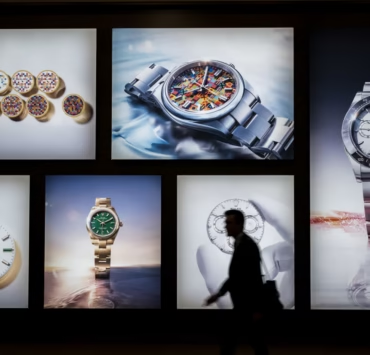

Watchmaking faces a new technological threat as counterfeits reach extraordinary levels of precision


For decades, identifying a counterfeit luxury watch was relatively straightforward for an experienced professional. Poorly printed dials, incorrect indices, low-quality movements, differences in weight, inadequate finishing or small errors in logos and typography could quickly reveal that a watch was not authentic. That environment is changing. A new generation of counterfeits commonly known as “super clones” is reaching levels of execution capable of making identification considerably more difficult, even for people familiar with high-end watchmaking. Recent investigations into this market have highlighted Rolex replicas that reproduce cases, bracelets, clasps, dials, movements and microscopic details with a degree of precision that challenges many of the traditional methods used to identify a fake. In certain circumstances, an initial visual inspection may no longer be enough, making it necessary to open the watch, examine internal components and verify serial information, documentation and service history.
The problem extends far beyond Rolex. The higher the value and liquidity of a reference on the secondary market, the stronger the economic incentive to reproduce it convincingly. Patek Philippe, Audemars Piguet, Cartier, Omega and other leading manufacturers operate within a market where individual watches can command tens or hundreds of thousands of dollars. A counterfeit capable of surviving a superficial inspection therefore ceases to be merely a cheap imitation of a maison’s aesthetic and potentially becomes a sophisticated instrument for deceiving buyers, intermediaries and resale platforms.
The technology protecting luxury can also be used to copy it
Part of the paradox is that the problem has been enabled by extraordinary advances in manufacturing technology. High-precision CNC machinery, three-dimensional scanning, advanced production techniques, reverse engineering, improved metallurgy and globalised supply chains can reproduce components to tolerances that would have required far more sophisticated industrial infrastructure two decades ago.
There is also an extraordinary amount of information available about authentic watches. Macro photography, teardown videos, catalogues, databases, specialist forums, technical documentation and detailed movement analysis make it possible to study almost every component of a reference. As the digital collecting ecosystem becomes more transparent, more information also becomes available to those attempting to reproduce the products.
This raises an uncomfortable question for the industry: manufacturing quality alone may eventually cease to be sufficient as a mechanism of authenticity. If physical characteristics can increasingly be replicated, value will also need to rely on elements that are considerably harder to copy.
The greatest risk lies in the secondary market
The threat becomes considerably more important because of the expansion of pre-owned luxury. Watches are no longer purchased exclusively through official boutiques or authorised dealers. Digital platforms, independent dealers, auction houses, marketplaces and private transactions have transformed second-hand watchmaking into a global industry.
For the major maisons, this market has a dual importance. On the one hand, it strengthens the value of certain models because it demonstrates what buyers are willing to pay years after the original purchase. On the other, it increases the number of transactions taking place outside environments directly controlled by the brand.
A customer paying $20,000, $50,000 or $100,000 for a pre-owned watch needs an exceptionally high level of certainty regarding authenticity. If that confidence begins to deteriorate, the entire ecosystem can be affected: buyers, dealers, platforms, insurers, auction houses and manufacturers.
Sophisticated counterfeiting therefore ceases to be merely an intellectual-property problem. It becomes a financial trust problem.
Traceability could become part of the product itself
One of the most interesting responses may be to transform authenticity into a permanent technological characteristic of the watch. Instead of relying exclusively on an expert deciding whether a piece appears genuine, each watch could carry a verifiable digital identity from the moment it is manufactured.
Digital product passports, cryptographic records, secure NFC chips, manufacturer-controlled databases or digital certificates could connect the physical object with information relating to production, serial number, original sale, servicing and subsequent interventions. The objective should not simply be to issue a digital certificate at the moment of purchase, but to create a chain of provenance throughout the entire life of the watch.
The implications for the secondary market would be considerable. A buyer could verify that a particular reference was manufactured by the maison, confirm elements of its history and determine whether recorded services were completed by authorised workshops. Provenance could ultimately become as important as physical condition.
After-sales service can become an authentication tool
Manufacturers’ service networks possess another advantage that is extremely difficult to reproduce. Every time a watch enters an authorised service centre, it can potentially be verified, documented and added to its history. Maintenance can therefore become more than a repair: it can act as a periodic renewal of confidence in the object.
This creates a strategic opportunity for major brands. Historically, some manufacturers maintained a certain distance from the secondary market. As sophisticated counterfeits become more convincing, however, the value of participating in authentication, certification and servicing after the first sale increases substantially.
Certified pre-owned programmes could consequently become far more important. They allow brands not only to capture part of the economic value generated during the second life of their products, but also to provide a level of assurance that independent sellers may find difficult to replicate.
Artificial intelligence will be both part of the problem and part of the solution
AI will add another layer to this technological battle. Computer-vision systems can analyse high-resolution images and detect extremely subtle differences in typography, finishing, alignment, geometry or components. Combined with databases of authentic pieces, such systems could become powerful tools supporting human specialists.
The same technology, however, can potentially be used to study precisely which differences reveal a counterfeit and improve the next generation of replicas. The result could be an ongoing technological race between authentication and reproduction, similar to those already seen in cybersecurity, financial fraud and document forgery.
The maisons’ greatest advantage may ultimately lie in something counterfeiters cannot easily reproduce: the original data generated within the manufacturing chain. If a watch receives a verifiable identity from the moment of creation within systems controlled by the manufacturer, reproducing its physical appearance alone becomes far less useful.
Buyers may increasingly pay for certainty
This evolution could even alter the concept of value within high watchmaking. Until now, customers have primarily paid for brand, movement, design, materials, craftsmanship, scarcity, complications and heritage. In the future, another attribute could become equally fundamental: certainty of authenticity.
Two physically identical watches could command very different values if one possesses fully documented provenance while the other contains substantial gaps in its history. This is already familiar in classic automobiles, art and high jewellery, where provenance can radically alter valuation.
Watchmaking appears to be moving towards the same model. Boxes and papers will remain important, but they may no longer be enough. The real asset could become a verifiable history capable of accompanying a watch for decades.
Authenticity could become the new invisible luxury
Extremely sophisticated counterfeits represent a threat, but they may also accelerate a transformation the industry increasingly needs. If manufacturers respond effectively, the next generation of luxury watches will not simply become mechanically more complex or aesthetically more sophisticated. They will also become considerably more traceable.
For Rolex, Patek Philippe, Audemars Piguet, Cartier, Omega and the rest of the world’s leading manufacturers, protecting the future value of their watches also means protecting the confidence of customers purchasing those pieces ten, twenty or fifty years after they were originally made.
Luxury has always depended upon a combination of reality and trust. A client needs to know that a diamond is genuine, that a work belongs to the artist, that an automobile possesses the stated provenance and that a watch genuinely emerged from the manufacturer’s workshops.
In a world where appearance can increasingly be copied with extraordinary accuracy, true exclusivity may ultimately belong to what can be proven authentic beyond doubt.
Prepare to lead the new challenges facing luxury
The transformation of high watchmaking demonstrates how technology, artificial intelligence, traceability, secondary markets and brand protection are becoming strategic issues for every executive in the luxury industry.
The MBA in Luxury Management at LUXONOMY University is designed for professionals who want to understand these changes and master strategy, marketing, innovation, artificial intelligence, retail, consumer behaviour and the international management of luxury brands.
Recognised as the leading online MBA in Luxury Management by U.S. News and delivered by an institution whose degrees are accredited through SACSCOC, the programme provides a global perspective on the challenges and opportunities redefining the future of luxury.
Discover the MBA in Luxury Management at LUXONOMY University
Discover more from LUXONOMY
Subscribe to get the latest posts sent to your email.