
Porsche begins a new industrial era as it turns AI into core infrastructure


Porsche reorganises its structure while preparing for a much deeper transformation
Porsche is entering a new industrial era in which artificial intelligence is no longer treated as an experimental tool but as part of the infrastructure on which it intends to build manufacturing, engineering, operations and customer experience. The shift coincides with an important transition in Production and Logistics: Albrecht Reimold is concluding his tenure on the Executive Board, with Christian Friedl taking over these responsibilities, at a particularly challenging moment for the German manufacturer. Porsche must simultaneously manage electrification, pressure on margins, uneven international demand, increasing technological complexity and an industrial transformation that requires the company to reconsider which capabilities it should control internally and which can be developed through global technology partners.
The transaction that best represents this new philosophy is the five-year strategic alliance established with Tata Consultancy Services (TCS). The objective goes far beyond purchasing conventional IT services. Porsche wants to embed digital capabilities and artificial intelligence across manufacturing, engineering, operations and customer experience. At the same time, TCS will acquire MHP, the technology consultancy created by Porsche, in a transaction valuing the business at approximately €320 million in enterprise value. The architecture is particularly interesting: Porsche is reducing its direct exposure to a technology consulting business while securing access to a global organisation with far greater scale to support its digital transformation.
AI is moving from technology project to factory infrastructure
During the early years of the current artificial intelligence revolution, many industrial companies treated AI as a collection of isolated projects: an employee chatbot, a forecasting tool, automation for selected administrative tasks or small production pilots. The next stage is fundamentally different. AI is beginning to become embedded within the company’s operational architecture itself.
For a manufacturer such as Porsche, the potential applications are enormous. Systems can analyse information from production lines to identify anomalies before they cause stoppages, use computer vision to support quality control, optimise production sequences, anticipate maintenance requirements, improve logistics planning and detect component-related deviations earlier. In engineering, AI can accelerate the analysis of large volumes of information, support selected phases of simulation and reduce the time engineers spend on repetitive processes. Across the supply chain, it can improve forecasting and identify potential risks earlier.
The business objective should not simply be to “use AI”. The real objective is to make every Porsche faster, more precise, more flexible and more profitable to produce without compromising what makes a Porsche a Porsche.
Porsche is redefining what should remain in-house and what can be purchased as a service
The sale of MHP is particularly revealing because it raises a question that virtually every major manufacturer will face over the coming years: which technological capabilities should be considered strategic, and which can be developed more effectively through specialist companies?
For years, many corporations attempted to internalise vast amounts of technological expertise because they feared becoming excessively dependent on external providers. The current acceleration of AI is changing that equation. Maintaining competitive internal capabilities across AI models, cloud infrastructure, cybersecurity, data engineering, automation and enterprise software requires enormous investment and highly specialised talent.
Porsche appears to be moving towards a more selective architecture: control what differentiates the automobile and rely on partners with global scale for part of the infrastructure required to build it. Brand, design, driving dynamics, customer knowledge, differentiated engineering and critical intellectual property need to remain under Porsche’s control. Horizontal technological capabilities, by contrast, may benefit from a partner operating across multiple industries and capable of spreading investment across a much larger customer base.
The premium automobile is increasingly becoming a software-defined product
This transformation matters even more because the value of an automobile is no longer concentrated exclusively in its engine, chassis, materials and design. Software, digital systems, interfaces, connectivity, remote updates, intelligent assistants and post-purchase services represent a growing part of the experience.
For a luxury company, this creates an additional challenge. A Porsche customer does not simply expect technology to work. They expect it to work in a way that is consistent with the positioning of the brand. A slow interface, unintuitive system or digital failure can damage the perception of a six-figure automobile even when its mechanical engineering is exceptional.
Artificial intelligence can help transform that relationship. A vehicle could learn preferences relating to climate, navigation or particular configurations, anticipate needs and simplify interaction with the brand’s services. But there is a fundamental boundary: personalisation must not become intrusion. Data protection, privacy, cybersecurity and transparency will become increasingly important as AI learns more about individual drivers.
AI could also transform personalisation
This is where one of the most interesting opportunities for Porsche emerges. Luxury automotive is increasingly shifting value towards personalisation. Special paints, materials, interiors, Exclusive Manufaktur programmes and virtually unique configurations allow manufacturers to increase revenue per vehicle without necessarily increasing production volumes.
Artificial intelligence could dramatically strengthen this business. A system could help customers explore thousands of combinations, visualise configurations with exceptional realism, recommend compatible materials or create proposals based on individual preferences. For sales advisers, AI could become a tool for understanding customer history more deeply and presenting more relevant configurations.
This could fundamentally change the role of the configurator. Instead of functioning as a digital catalogue where customers select options, it could evolve into an AI-assisted co-creation experience, much closer to the logic of an atelier.
For a company such as Porsche, this is particularly attractive because personalisation does more than increase revenue. It also strengthens emotional attachment. A customer who has participated deeply in creating a vehicle is less likely to perceive it as interchangeable with another automobile.
Efficiency is becoming essential in an industry that requires enormous amounts of capital
There is also a financial rationale behind the transformation. Developing premium automobiles is becoming extraordinarily expensive. Manufacturers need to finance electric platforms, combustion engines, hybrids, software, batteries, advanced driver-assistance systems, cybersecurity, factories and increasingly complex regulatory requirements simultaneously.
Not all these investments can be sustained indefinitely through traditional structures. Artificial intelligence offers an opportunity to increase productivity precisely when the industry needs to release capital.
Reducing development times, detecting defects earlier, lowering inventory levels, improving maintenance and automating administrative processes can generate substantial cumulative savings. In a company manufacturing high-value products, small improvements repeated thousands of times can have a considerable impact on margins.
The objective should not be indiscriminately replacing employees with algorithms. It should be enabling engineers, designers, production specialists and commercial teams to spend less time on repetitive tasks and more time on activities where human expertise creates differentiation.
That distinction will be especially important in luxury. Efficiency creates value only when it protects — rather than erodes — the characteristics for which customers are willing to pay a premium.
The transformation also creates new risks
Turning AI into infrastructure means accepting new forms of risk. An error in a system used to generate a marketing campaign is fundamentally different from an error in a system connected to manufacturing, engineering or decisions related to an automobile. The deeper artificial intelligence becomes embedded in operations, the stronger governance needs to become.
Porsche will need to manage data quality, traceability, human oversight, cybersecurity, intellectual property, technology suppliers and regulatory compliance. In Europe, this transformation is also taking place within an increasingly demanding regulatory environment surrounding artificial intelligence and data.
Competitive advantage will therefore not come simply from adopting AI before competitors. It will come from industrialising AI with sufficient governance to make it trustworthy.
This is one of the most important distinctions between experimentation and genuine transformation. A proof of concept can tolerate imperfections. Infrastructure cannot.
Porsche could become a laboratory for the entire luxury industry
The most interesting aspect of Porsche’s strategy is that its implications extend far beyond automotive. The same questions are appearing across fashion, beauty, watchmaking, jewellery and hospitality. Which processes can be automated? Which expertise must remain inside the maison? Where does AI create genuine value? Which parts of the product should deliberately continue to depend on human knowledge and craftsmanship?
In luxury, the answer will differ from other industries because efficiency cannot be allowed to become homogenisation. A luxury handbag, automobile, hotel or watch must retain a human, cultural and emotional dimension.
This is why the architecture Porsche is building is particularly interesting: use technological scale behind the product to protect and enhance what must remain exceptional in front of the customer.
The distinction could become one of the defining principles of AI adoption across the luxury industry. Artificial intelligence should not necessarily replace the artisan, designer, engineer or adviser. In many cases, its greatest value will be removing everything that prevents those people from spending more time on the work that genuinely differentiates the brand.
The real revolution will be invisible
The greatest success of this strategy will probably arrive when customers stop noticing the artificial intelligence altogether. They should not buy a Porsche because it “has AI”. They should notice that their vehicle arrives sooner, has fewer problems, can be personalised more effectively, receives more precise service and maintains a smoother relationship with the brand.
Technology will then have fulfilled its true purpose: disappearing behind a superior experience.
That could become one of the fundamental principles of luxury over the next decade. The best artificial intelligence will not necessarily be the most visible, but the one that allows everything human, artisanal, emotional and exceptional to work even better.
Porsche is therefore doing more than introducing AI into its operations. It is beginning to decide what kind of automotive company it wants to become when artificial intelligence is embedded across virtually every industrial process.
And that decision could ultimately prove far more important than any individual model it launches next.
Prepare to lead the transformation of luxury
Porsche’s transformation demonstrates that managing a luxury company increasingly requires an understanding of strategy, artificial intelligence, operations, innovation, supply chain, customer experience and international management simultaneously.
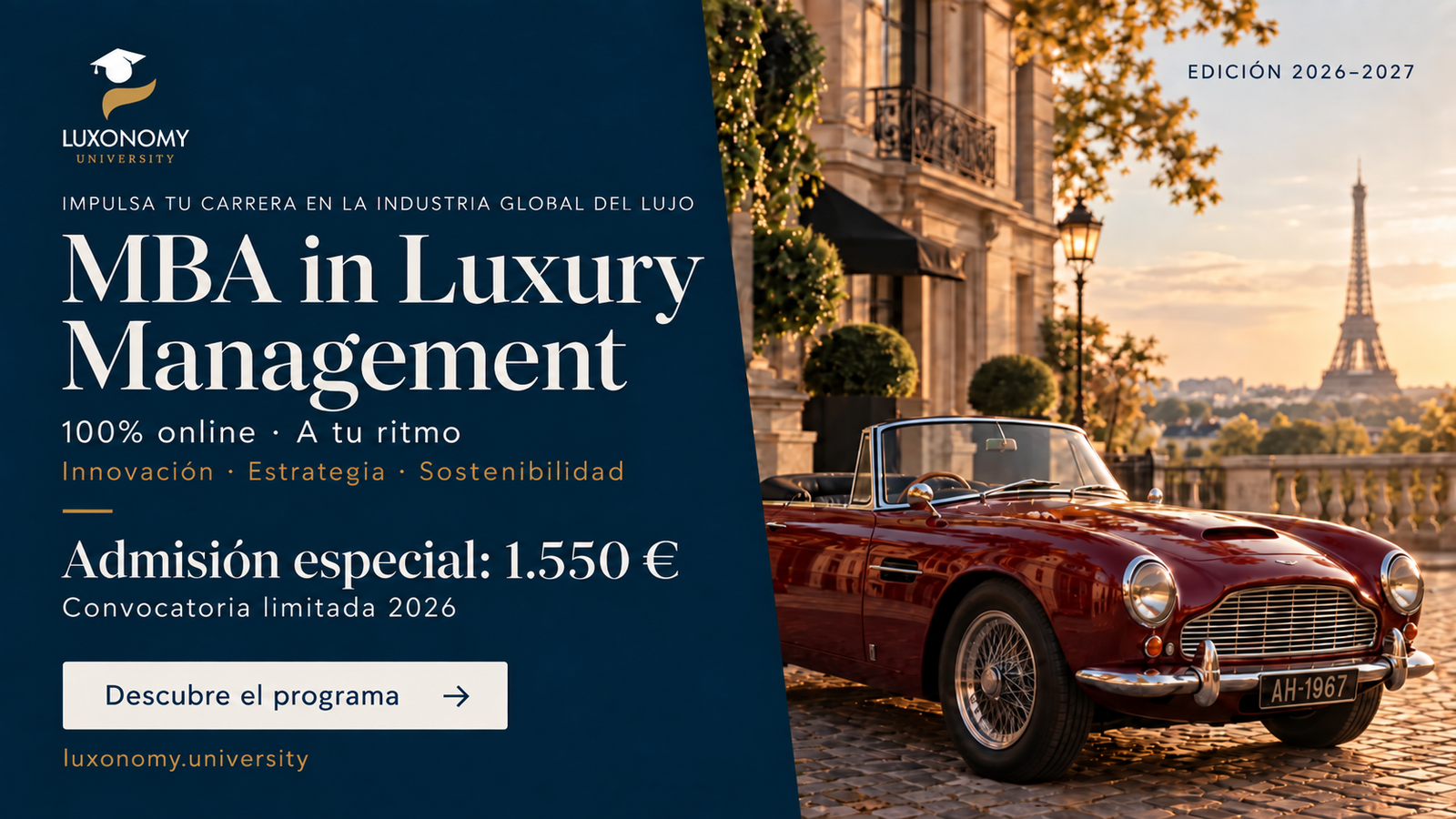
The MBA in Luxury Management at LUXONOMY University is designed for professionals who want to develop this integrated perspective and prepare to lead the next generation of luxury companies.
Recognised as the leading online MBA in Luxury Management by U.S. News and delivered by an institution whose degrees are accredited through SACSCOC, the programme provides a global perspective on strategy, marketing, innovation, retail, hospitality, artificial intelligence and the international management of luxury brands.
Discover more from LUXONOMY
Subscribe to get the latest posts sent to your email.