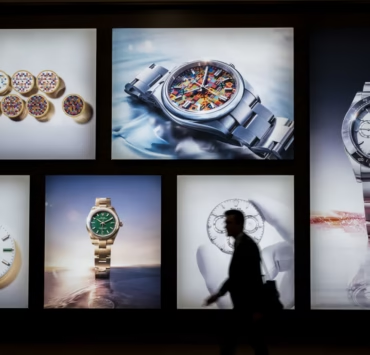
Bangkok is becoming part of the new geography of watch collecting


The significance of Bangkok Watch Week extends beyond the event itself. For decades, the international calendar of high watchmaking was extraordinarily concentrated. Geneva and Switzerland naturally occupied the centre, while major commercial hubs such as Hong Kong, Singapore, New York and Dubai developed their own increasingly influential collecting communities. Bangkok is now attempting to establish itself within that geography by combining three assets: a growing affluent consumer base, one of Southeast Asia’s strongest luxury retail infrastructures and the ability to attract collectors from neighbouring markets.
Thailand also has an advantage that should not be underestimated: tourism and luxury consumption already coexist naturally in Bangkok. The city receives millions of international visitors while simultaneously offering some of Asia’s most sophisticated shopping centres, hospitality, gastronomy and wellness experiences. A collector travelling to Bangkok for a watch event can therefore combine the trip with five-star hotels, Michelin-starred restaurants, private experiences, jewellery, fashion and other luxury purchases. This creates an ecosystem that can make the watch event itself considerably more valuable.
Southeast Asia is becoming strategically important for Swiss watchmaking
The rise of Bangkok also reflects a broader geographical shift. China remains fundamental to the global luxury industry, but its weaker performance has forced brands to diversify their exposure across Asia. Singapore already possesses an exceptionally sophisticated collector community, while Thailand, Malaysia, Indonesia, Vietnam and the Philippines represent different combinations of wealth creation, demographic growth and increasing luxury consumption.
For watch manufacturers, this means Southeast Asia cannot simply be treated as an extension of the Chinese market. Consumers have different cultures, purchasing behaviours and relationships with luxury. Building relevance requires local events, retail investment, collector communities and relationships that extend beyond conventional advertising.
Bangkok Watch Week can therefore function as a regional platform rather than merely a Thai event. A collector from Vietnam, Indonesia or Malaysia may find it considerably easier to travel to Bangkok than Geneva, particularly when the event combines multiple maisons in one destination.
That geographic accessibility could become one of Bangkok’s strongest competitive advantages.
The event itself is becoming part of the luxury product
There is also a deeper transformation taking place within watchmaking. For years, the industry concentrated primarily on selling watches. Today, leading manufacturers increasingly understand that the community surrounding the watch can be almost as important as the object itself.
Private dinners, conversations with watchmakers, previews, collector meetings, masterclasses and opportunities to handle exceptional pieces create emotional connections that conventional retail cannot easily reproduce. The customer does not simply acquire a watch; they enter a world of knowledge, relationships and privileged access.
This is particularly important at the highest end of the market. A customer spending tens or hundreds of thousands of euros on a watch increasingly expects something beyond the transaction. Access to the manufacture, conversations with artisans, private events and relationships with senior representatives of the maison can become part of the value proposition.
Bangkok therefore does not need to replace Geneva to become important. It needs to create a sufficiently powerful collector ecosystem that maisons begin reserving products, experiences and launches specifically for the city.
Independent watchmaking could be one of the greatest beneficiaries
One of the most interesting dimensions of this new geography concerns independent watchmakers. Established names such as Rolex, Cartier, Omega or Patek Philippe already possess enormous international awareness. Smaller independent manufacturers operate differently. Their growth often depends heavily on collectors, specialist retailers, personal recommendation and opportunities to explain why their watches are exceptional.
Events provide precisely that environment.
A collector who already owns watches from the major maisons may eventually begin searching for something more unusual: smaller production, direct relationships with creators, distinctive movements or pieces that few other people recognise. This progression is similar to what happens in wine, art or automotive collecting. As knowledge increases, consumption often becomes more specialised.
Southeast Asia contains a growing population of precisely these sophisticated collectors. Bangkok can therefore become an important discovery platform for independent watchmaking, potentially benefiting brands that cannot replicate the enormous marketing budgets of the largest groups but can compete through craftsmanship, rarity and intellectual depth.
Geneva will remain the capital, but it no longer needs to be the only capital
It would be an exaggeration to suggest that Bangkok is about to displace Geneva. Switzerland possesses something that cannot be recreated simply by organising a successful event: centuries of watchmaking history, manufactures, suppliers, specialist craftspeople, museums, auction houses and an industrial ecosystem that makes Geneva the natural centre of haute horlogerie.
But the future of luxury does not necessarily require a single centre.
Paris remains fundamental to fashion while Milan, London, New York, Seoul and Shanghai exert enormous influence. Art operates through New York, London, Paris, Hong Kong, Basel and other centres. Automotive collecting can concentrate in Monterey for one week and elsewhere during the rest of the year.
Watchmaking can follow the same model.
Geneva can remain the industrial and cultural capital while Bangkok becomes one of the major commercial and collector capitals of Asia.
That distinction is important. The growth of Bangkok does not weaken Geneva; it expands the global ecosystem of high watchmaking.
Bangkok could become a complete luxury destination around watches
The greatest opportunity lies in what happens around the event. A major international watch week can generate demand for hotels, restaurants, private aviation, luxury retail, jewellery, transportation and cultural experiences. It can attract collectors who subsequently return to the city independently.
This is where Bangkok possesses considerable potential. Its hospitality infrastructure is already extraordinary. Mandarin Oriental, Capella, Four Seasons and numerous other high-end properties provide an established ecosystem for private dinners, collector events and brand activations. Its shopping centres already accommodate many of the world’s leading maisons, while the city possesses a strong gastronomic and cultural identity.
The next step could be to connect these elements more deliberately: watch launches inside hotels, private dinners with collectors, exhibitions, auctions, meetings with watchmakers and bespoke cultural experiences organised around the main event.
At that point, Bangkok Watch Week would cease to be simply a trade or retail event and become a luxury destination experience.
The battle is ultimately for the collector’s time
This is perhaps the most important strategic lesson. Geneva, Dubai, Singapore, Hong Kong, New York, Aspen and now Bangkok are not simply competing for watch sales. They are competing for something much more valuable: the time and attention of the world’s most important collectors.
If a collector chooses to spend four days in Bangkok attending presentations, dinners and private appointments, that creates an extraordinary opportunity for brands. The relationship can extend far beyond the purchase of a single watch.
This reflects a broader transformation across luxury. The strongest companies increasingly understand that controlling more of the customer’s time can be more valuable than simply selling another product.
Watchmaking is particularly suited to this model because it combines craftsmanship, engineering, history, collecting and community. A watch can be purchased in minutes, but understanding and appreciating it can occupy a lifetime.
A new Asian watchmaking map is emerging
Bangkok Watch Week therefore deserves attention not simply because more than 45 maisons will participate or because more than 200 novelties will be presented. Its real importance lies in what it reveals about the changing geography of luxury.
The centre of wealth creation is becoming more distributed. Collectors are becoming more knowledgeable. Brands need deeper relationships with clients. Events are evolving from trade fairs into cultural and community platforms. And Southeast Asia is becoming increasingly important within the global luxury economy.
Geneva will continue to possess something Bangkok cannot reproduce: the heritage and industrial infrastructure of Swiss watchmaking.
Bangkok, however, possesses something different: access to a rapidly developing regional luxury ecosystem, international tourism and a new generation of Asian collectors.
The future of high watchmaking may therefore not involve replacing one capital with another. It may involve creating a network of global capitals, each playing a different role.
And Bangkok is making a serious bid to become one of them.
Prepare to lead the new geography of global luxury
The rise of Bangkok as a watchmaking and collecting destination demonstrates how rapidly the geography of luxury is changing. Understanding these shifts requires executives capable of analysing international markets, consumer behaviour, retail, collecting, hospitality, technology and brand strategy simultaneously.
The MBA in Luxury Management at LUXONOMY University is designed for professionals who want to understand and lead this transformation of the global luxury industry.
Recognised as the leading online MBA in Luxury Management by U.S. News and delivered by an institution whose degrees are accredited through SACSCOC, the programme provides a global and forward-looking perspective on strategy, marketing, innovation, retail, hospitality, artificial intelligence and the international management of luxury brands.
Discover the MBA in Luxury Management at LUXONOMY University
Discover more from LUXONOMY
Subscribe to get the latest posts sent to your email.