



Description
LUXONOMY · Global Luxury Intelligence
The new global landscape of luxury residential real estate
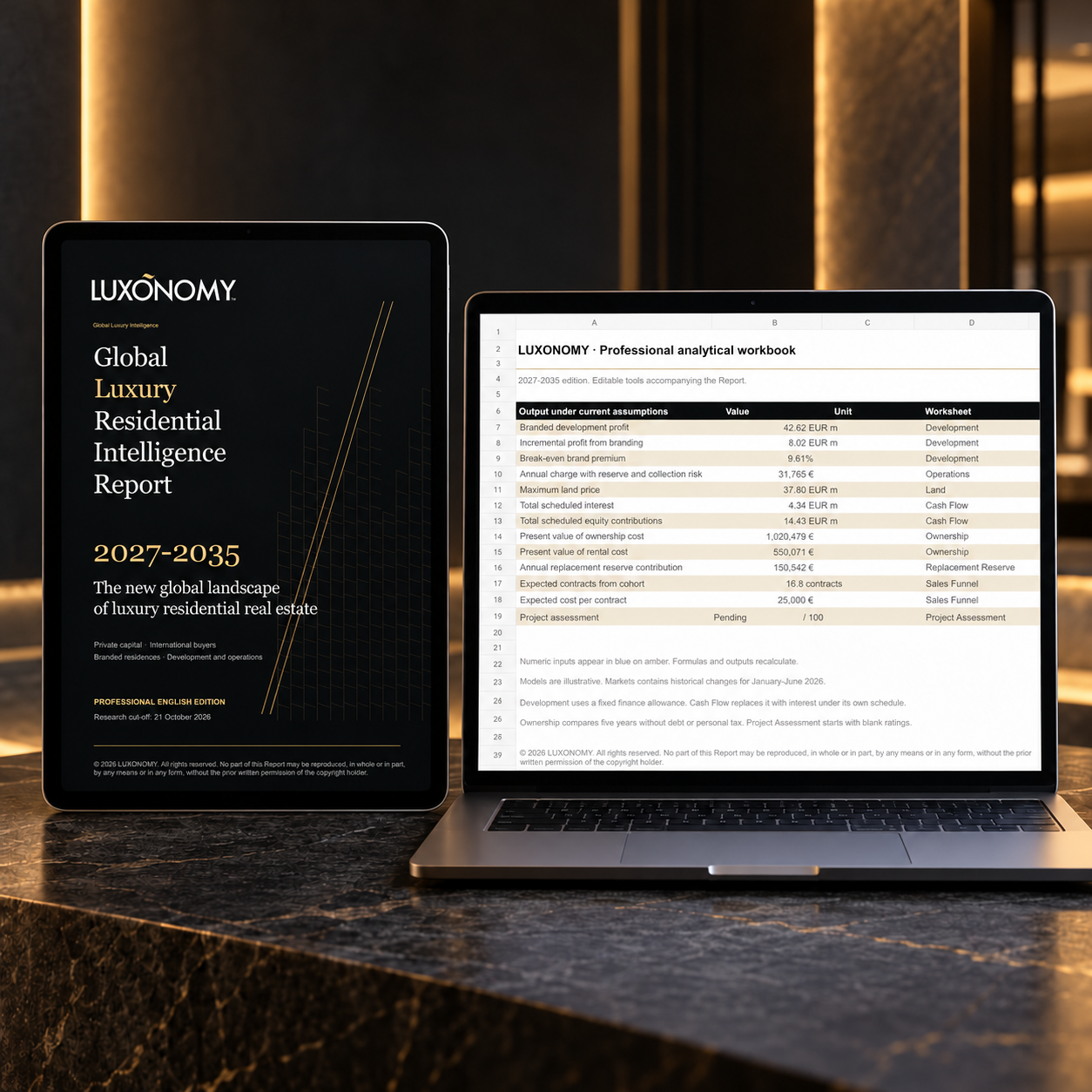
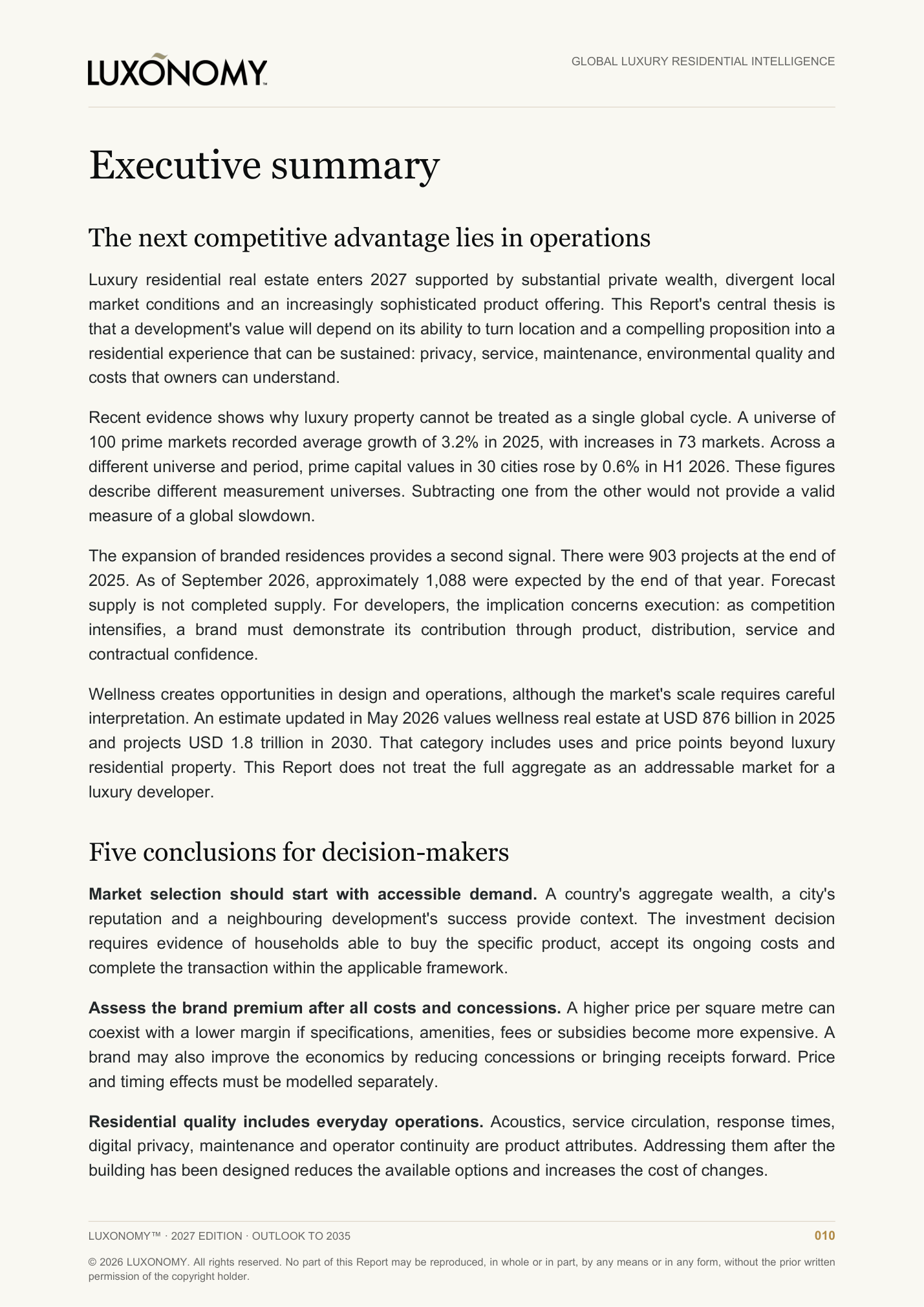
Global Luxury Residential Intelligence Report 2027–2035 is an international strategic report for professionals who need to connect markets, buyers, product design, financing and operations. It examines prime residential property, branded residences and serviced homes, with editable tools for testing the assumptions behind a specific project.
This professional English edition includes a 128-page report, 28 chapters, ten practical appendices and an Excel workbook with ten worksheets and 238 formulas. It turns market questions into selection criteria, budgets, scenarios and documented decisions.
What your purchase includes
- Complete report in PDF: professional English edition with front and back covers, executive summary, application guide, a linked three-level contents section, charts, tables, worked examples and methodology.
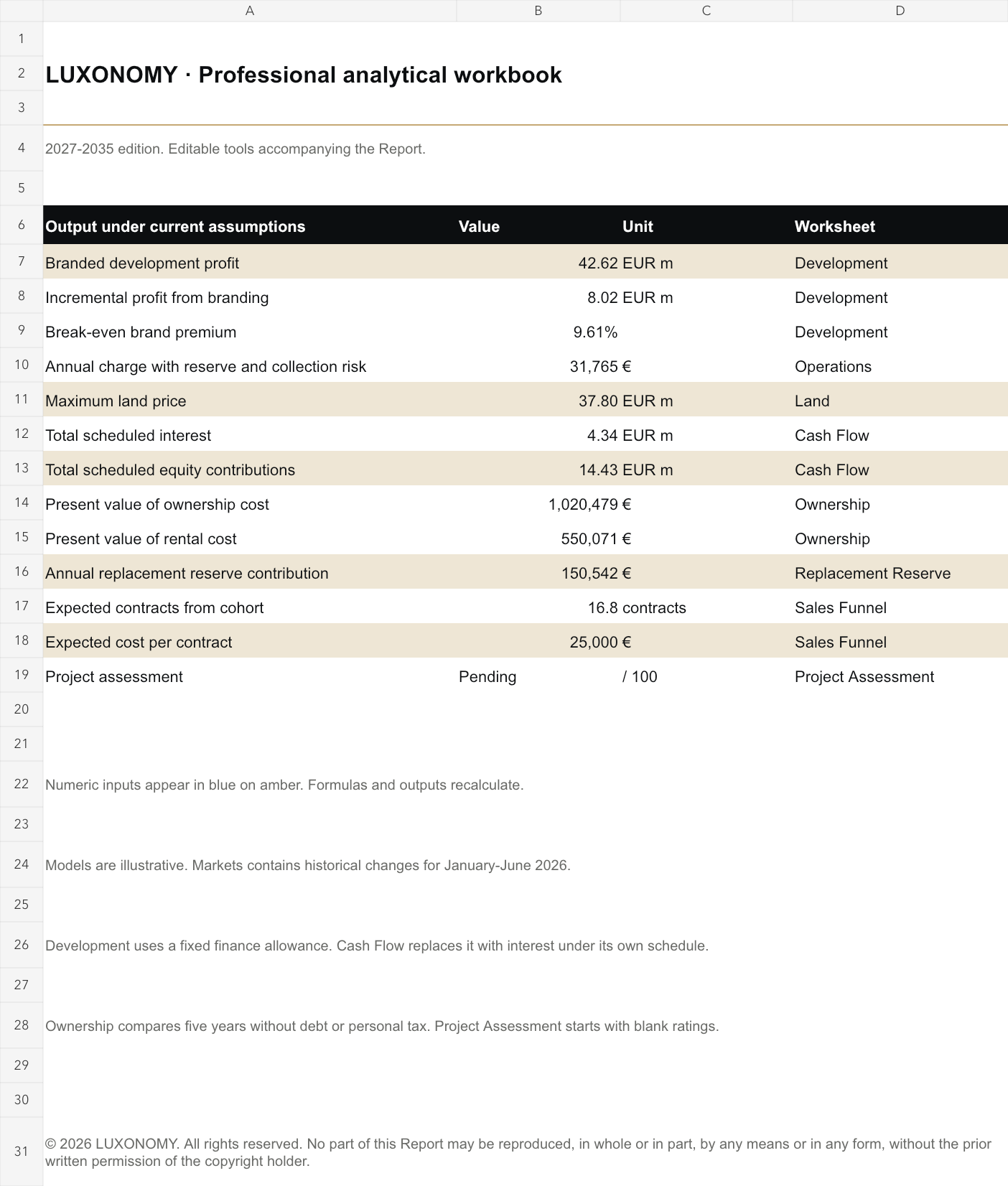
- Editable analytical workbook in XLSX: ten worksheets with linked formulas, clearly identified inputs and outputs that recalculate when assumptions change.
- Ten appendices within the PDF: due diligence, brand and operator selection, investment committee templates, sales controls, asset handover and project assessment.
- Decision workshop: three worked cases connecting the analysis to development, acquisition and operating decisions.
Digital delivery: two downloadable files, PDF and XLSX, supplied together as one package. Product mockups illustrate the digital materials; printed books and devices are not included.
Preview the English edition

Decisions the report helps you structure
- Select a market and location: assess the destination’s role, accessible demand, comparable evidence, competing supply and acquisition conditions.
- Define the buyer and product: connect purchase purpose, layouts, amenities, wellness, privacy and the full cost of ownership.
- Assess a residential brand: compare pricing, additional costs, licensing, distribution, service obligations and continuity.
- Evaluate acquisition and development: calculate an illustrative residual land budget, development profit and scheduled debt and equity requirements.
- Prepare the launch: examine pricing, absorption, concessions, conversion and expected cost per contract.
- Sustain service and use value: budget service charges, collection risk, replacement reserves, maintenance and the transition into operations.
- Document a wealth decision: compare alternatives, establish essential prerequisites and define governance, monitoring and outstanding conditions.
International coverage
The report combines a historical comparison of 23 cities with market profiles and regional perspectives. Coverage includes North America, Europe, the Middle East, Asia-Pacific and selected destinations in Latin America and Africa. Markets discussed include New York, Miami, London, Paris, Milan, Rome, Lisbon, Madrid, Barcelona, Geneva, Amsterdam, Dubai, Abu Dhabi, Tokyo, Seoul and Singapore.
Cities, regions and resort destinations are assessed according to their own conditions. Product hypotheses are paired with evidence required for validation. The quantitative comparison retains its historical reference period and is not an investment ranking.
Inside the report: all 28 chapters
- Defining the market
- Wealth, mobility and buyers
- Reading the cycle with comparable data
- A global map of opportunities and conditions
- Branded residences: growth and contractual discipline
- Documented cases and development lessons
- Wellness, longevity and residential quality
- Development economics and value creation
- Operations, service charges and service continuity
- Design, technology and privacy as product attributes
- Marketing and access to demand
- Regulation, climate and risks affecting value
- Scenarios for 2027-2035
- The LUXONOMY framework for project assessment
- Turning global analysis into a regional strategy
- Buyers: segmentation and proposition design
- Product architecture and amenity economics
- Residual land value and acquisition terms
- Cash flow, debt and equity: from margin to timing
- Ownership costs, personal use and the rental alternative
- Brand licensing: tendering, negotiation and control
- Pricing, absorption and launch strategy
- Replacement reserves, maintenance and economic resilience
- Refurbishment, conversion and repositioning
- Family offices and governance of property decisions
- Portfolio monitoring and triggers for change
- Implementation: from investment thesis to a twelve-month programme
- Decision workshop: three worked cases
The main chapters are complemented by an executive summary, a decision-based reading guide and a methodology and scope section.
Ten practical appendices
- Appendix A · Development due diligence
- Appendix B · Buyer due diligence and ownership costs
- Appendix C · Investment committee templates
- Appendix D · Glossary and formulas
- Appendix E · Brand and operator selection brief
- Appendix F · Sales inventory and concession control
- Appendix G · Investment committee memorandum
- Appendix H · Asset handover and the first 100 days of operations
- Appendix I · Project assessment worksheet
- Appendix J · Using the analytical workbook
The appendices are integrated into the PDF. The separate Excel file contains the ten worksheets below.
The analytical workbook: ten worksheets for applying the report
| Worksheet | Application |
|---|---|
| Overview | Consolidated view of calculated outputs and their supporting worksheets. |
| Development | Branded versus unbranded development: revenue, costs, profit, margins and the break-even brand premium. |
| Operations | Annual service budget, replacement reserve and calculated service charge per home under an assumed collection rate. |
| Land | Residual acquisition budget based on revenue, costs, target margin and acquisition costs as a share of land price. |
| Cash Flow | Six illustrative half-year periods showing receipts, payments, debt, interest, equity contributions and distributions. |
| Ownership | Five-year present-value comparison of buying and renting, including acquisition, holding and exit costs. |
| Replacement Reserve | Ten-year replacement schedule with cost inflation, an assumed reserve return and scheduled expenditure. |
| Sales Funnel | Cohort conversion from leads to expected contracts and estimated lead acquisition cost per contract. |
| Project Assessment | Weighted assessment across five dimensions, with space for evidence. Ratings start blank for the reader to complete. |
| Markets | Historical prime capital value and available rental changes for 23 cities over January–June 2026. |
How to use it: editable inputs appear in blue on an amber background. Replace the illustrative assumptions with those of your project and review the linked outputs. Initial financial inputs are examples, rather than market quotations, budgets or observed investment returns.
Who it is for
Residential developers; investors and acquisition teams; family offices; hospitality brands and residence operators; property consultants and advisers; sales directors; and architecture, product and asset management teams. The reading guide connects each professional decision to a practical working deliverable.
The LUXONOMY RESIDE approach
RESIDE organises evidence review, structuring and comparability, simulation, interpretation, decision tools and consistency checks. The report distinguishes historical indicators, forecasts, analytical hypotheses and recalculable examples, explaining the limits of each.
The 2027–2035 horizon relates to strategic perspectives and scenarios. It does not imply a live database or a precise forecast of an individual property’s future value.
Edition specifications
- Publisher: LUXONOMY.
- Language: English, throughout both files.
- Strategic horizon: 2027–2035.
- Research cut-off: 21 October 2026.
- Report: 128-page PDF with linked contents and 28 chapters.
- Tools: ten PDF appendices and a ten-worksheet XLSX workbook with 238 formulas.
- Requirements: a PDF reader and Microsoft Excel or a compatible XLSX application. Display and recalculation may vary between applications.
- Purchase model: a one-off purchase of this digital edition, without a subscription.
Frequently asked questions
Is the Excel workbook included?
Yes. Your purchase includes the complete report and editable workbook as two separate downloads.
Can I enter my own project assumptions?
Yes. Input cells allow you to replace the illustrative assumptions and recalculate the tools. Check units, time horizon and cost scope before applying the results.
Does the report cover every market worldwide?
Coverage is international and selective. The quantitative comparison includes 23 cities, while profiles and regional chapters extend the context. It is not a global census of transactions.
Are advice and updates included?
The purchase includes the two files in this edition. It does not include individual consultancy, asset valuations, automatic data updates or future editions.
Does the workbook calculate full IRR and tax?
The workbook examines the economic relationships described in its worksheets. It does not include a complete IRR model or each buyer’s personal tax position. Each tool states its assumptions and exclusions.
Will I receive a printed book?
No. Delivery is digital. Mockups are presentation images of the report and workbook.
Professional use and scope
For the purchaser’s analysis and internal use. Resale, redistribution and publication, in whole or in part, require LUXONOMY’s prior written permission. Illustrative models do not replace transaction-specific due diligence or legal, tax, technical and financial advice.
Discover more from LUXONOMY
Subscribe to get the latest posts sent to your email.