
Real Estate

Over the past decade, the Chinese international real estate investor has evolved from an opportunistic buyer into a highly strategic, long-term capital allocator. According to global consultancy data from firms such as JLL and Knight Frank, China remains one of the countries with the largest populations of High Net Worth Individuals (HNWIs), exceeding two million individuals with assets above one million dollars, alongside a steadily expanding Ultra HNWI segment (over 30 million dollars). While capital controls have reshaped outbound flows, the appetite for offshore real estate has not disappeared. It has become more selective, analytical and institutionally structured.
Today’s Chinese luxury property investor is driven by three core objectives: capital preservation in politically stable jurisdictions, geographic diversification away from domestic regulatory exposure, and multigenerational family planning. A fourth dimension has gained importance in recent years: global mobility linked to education, residency or international lifestyle positioning. In this framework, property is not merely a financial asset; it becomes a strategic instrument within a global family architecture.

Spain has moved decisively beyond its old image as a pleasant holiday destination to become one of the most compelling lifestyle-investment markets for Americans over 50, particularly those coming from Miami and South Florida. For this generation of investors—experienced, internationally minded, and increasingly focused on quality of life—luxury residential real estate in Spain offers something rare: the ability to align capital preservation, personal enjoyment, and long-term optionality in a single asset. Second homes that can evolve into retirement bases, residences designed for long seasonal stays, and properties capable of generating premium vacation-rental income now sit at the center of a growing transatlantic shift in real-estate thinking.
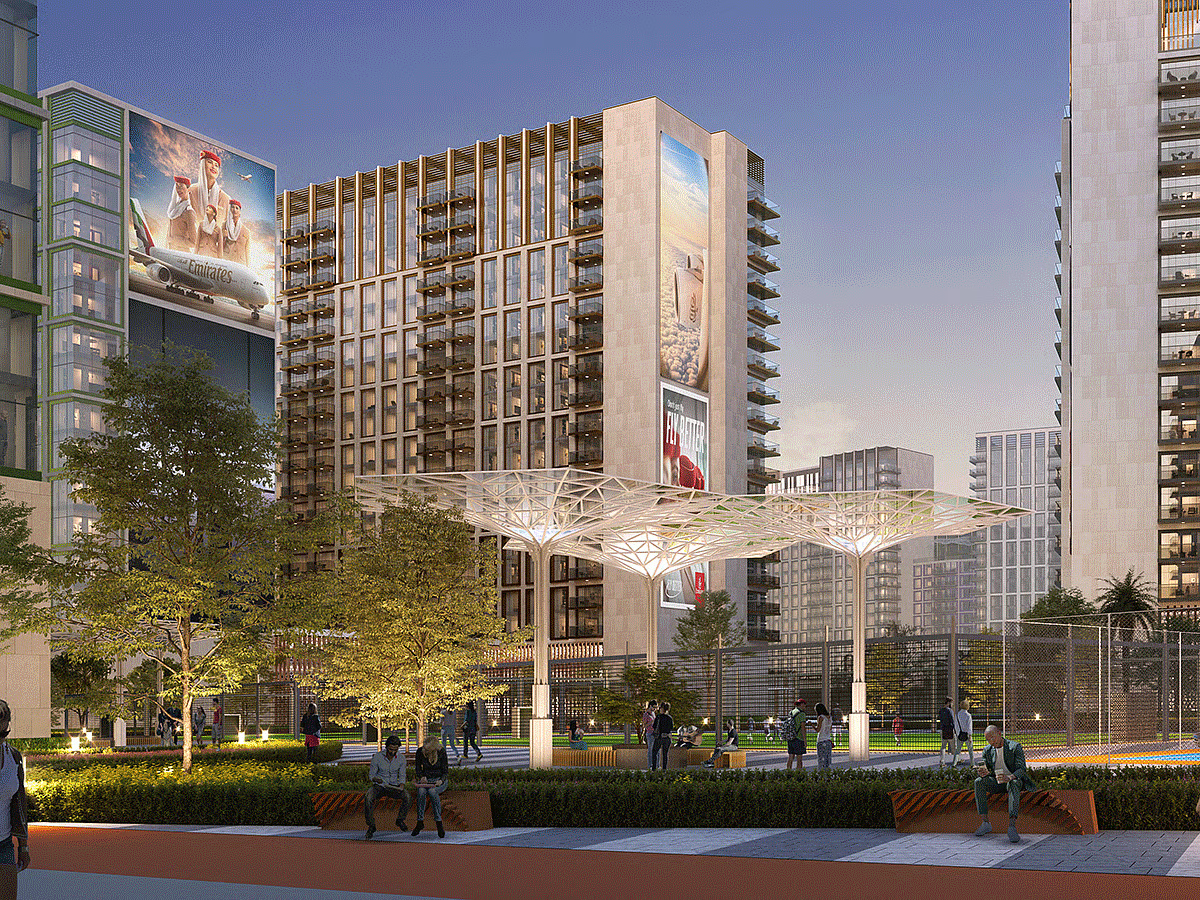
The airline Emirates has taken a decisive step to support its future expansion with the announcement of an agreement to develop a large-scale Crew Village at Dubai Investments Park. Backed by an investment running into several billion dirhams, the project reimagines how a global airline approaches residential living for its workforce while reinforcing Dubai’s ambition as a worldwide hub for aviation and talent.

Miami’s position as a global hub for ultra-luxury real estate is increasingly consolidated. Deals like the Surf Club residence point to a year shaped by selectivity, exceptional properties, and a market driven by vision rather than volume. In this environment, luxury real estate is no longer defined solely by square footage or price—but by lifestyle, permanence, and future-oriented living.

Dubai once again looks ahead of the global real estate curve with the launch of Mercedes-Benz Places – Binghatti City, a AED 30 billion (≈ USD 8.2 billion) urban development that redefines the scope of branded residences. Driven by Binghatti Developers in partnership with Mercedes-Benz, the project rises in Nad Al Sheba as a fully integrated “city within a city.”
With more than 13,000 homes across 12 landmark towers, the masterplan spans over 10 million square feet and will be delivered in three phases over approximately 3.5 years. The ambition goes beyond residential supply, introducing public spaces, green corridors and an urban infrastructure designed for a contemporary, high-end lifestyle.

The ultra-high-end residential market in South Florida is once again capturing global attention. In an international environment defined by capital seeking stability, long-term value and lifestyle quality, the region continues to strengthen its position as one of the most dynamic luxury real estate hubs worldwide.
2025 closed with 361 residential transactions priced at USD 10 million and above, making it the second-strongest year on record for this segment, surpassed only by the peak reached in 2021. The figures confirm a clear reality: demand for exceptional properties in South Florida is structural rather than cyclical.

These projects confirm that the future of high-end real estate lies in integrated urban environments capable of combining design, services, and flexibility within a framework of economic and environmental responsibility. Miami is entering a new phase in which luxury is defined not only by scale or location, but by its ability to predict the expectations of a global clientele and align investment, architecture, and lifestyle into a cohesive urban vision.

The geography of ultra-luxury real estate in the United States has just been redrawn. For the first time in nearly a decade, Silicon Valley has lost its long-standing dominance. In 2025, ZIP code 33109, home to Fisher Island, has been named the most expensive in the country, confirming Miami’s position as a global capital of extreme residential wealth.
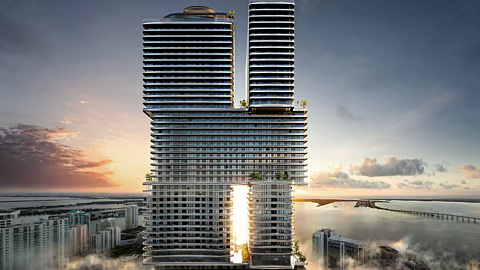
Miami is moving decisively toward 2026 as one of the world’s most influential markets for branded residences—a real estate model that blends residential architecture, elite hospitality and the creative DNA of leading fashion and lifestyle houses. In this new phase, the city is not merely adding iconic towers; it is redefining how luxury living is conceived, prioritizing integrated services, brand identity and offerings designed for multigenerational families and high-net-worth international buyers.

Dubai continues to strengthen its position as one of the world’s leading hubs for ultra-luxury residential property. According to the latest data published by Knight Frank, transactions involving homes priced above $10 million reached a historic $9.05 billion in 2025, driven by 500 completed sales. This signifies a 27.7% year-on-year increase, placing the emirate well ahead of traditional luxury residential markets.
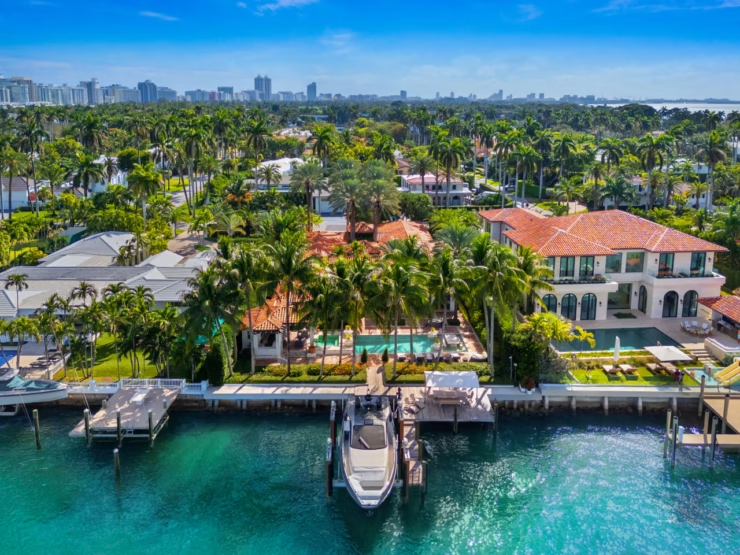
The recent move by Larry Page, co-founder of Google, into Miami’s ultra-luxury real estate market goes far beyond a conventional property acquisition. It signals a broader shift in how global wealth views residence, taxation, privacy, and lifestyle. With a joint investment approaching $173 million in two exceptional estates in Coconut Grove, Page aligns himself with a movement that is consolidating Miami as a new global capital of high-end residential living.

Billionaire investor Ken Griffin, founder of Citadel, is charting a new course for Miami’s waterfront with plans to build an ultra-exclusive private megayacht marina on Terminal Island. The proposed development, located at 120 MacArthur Causeway, would redefine private maritime luxury in one of the city’s most coveted locations.

Bvlgari Hotels & Resorts has signed an agreement with Eagle Hills to develop Bvlgari Resort…

The renowned German brand Brabus, famous for its high-end modifications of vehicles like Mercedes-AMG, has announced…

These majestic structures have witnessed history, housing kings, queens, aristocrats, and celebrities. Each of them…

When it comes to choosing their homes, high-net-worth individuals often have a unique set of…

The luxury housing market in India has shown remarkable growth driven by the demand from…

[lwptoc title=”Contents” toggle=”0″] Introduction The luxury real estate market in Seville has experienced remarkable growth…

In a world increasingly aware of environmental challenges, sustainability has become an unavoidable priority in…

In recent years, Madrid has emerged as an epicenter of luxury real estate investment, particularly…

Neuroarchitecture has found a valuable niche in the luxury sector, where user experience and well-being…

Miami, known for its sunny weather, stunning beaches, and distinct culture, has long been a…

In the heart of Malaga, the Sierra Blanca towers rise as a new symbol of…

At the intersection of luxury, innovative architecture, and sustainability, vertical gardens in skyscrapers are redefining…

When embarking on the search for a new home, especially on an international level, security…

The luxury real estate market continues to be a fertile ground for savvy investors. Some…

There is a unique transformation unfolding in the world of architecture and luxury branding. Major…

Welcome to our comprehensive guide on securing an incredible deal when purchasing ultra-luxury homes in…

In recent years, the luxury real estate sector has undergone a significant change in its…

According to a recent Sotheby’s International Real Estate report, certain home features are rapidly gaining…

While the super-tall, ultra-narrow concept for the LINE has made waves over the past two…

Property developer Binghatti has teamed up with luxury jewellery company Jacob & Co to build…